 MetalsAlloy
Wrought Aluminum 5283A
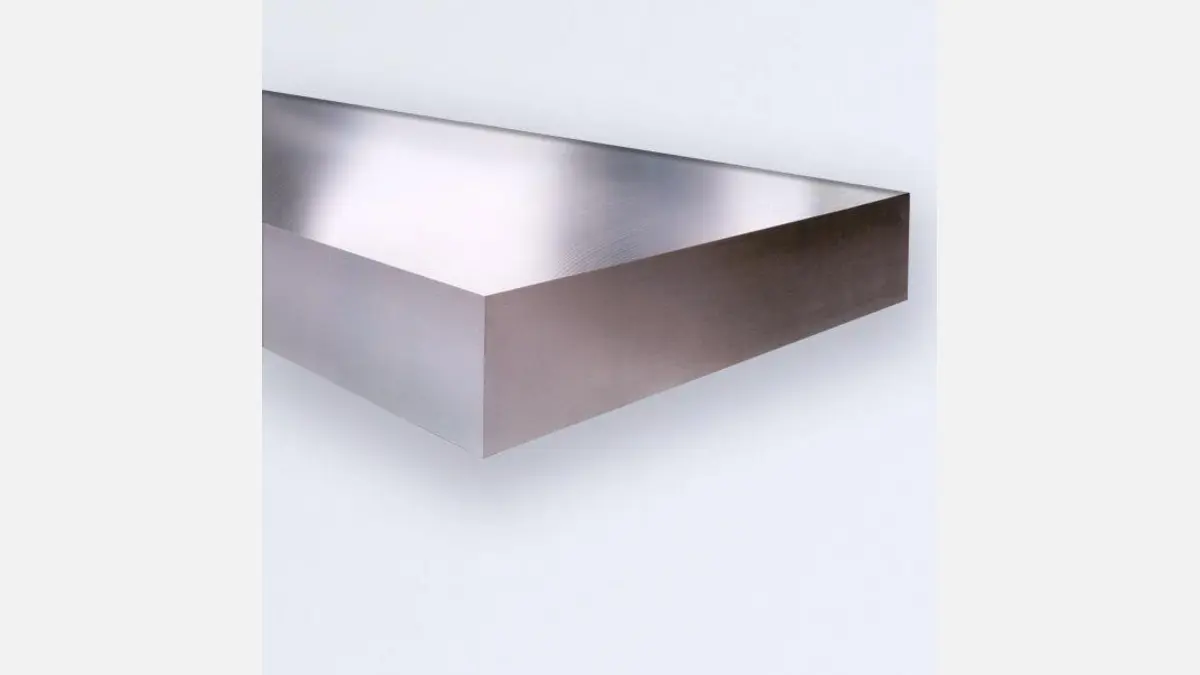
Image Credit: alro.com
Wrought Aluminum 5283A (AA 5283A) is a registered Al-Mg alloy in the 5xxx series. Its 4.5–5.1% magnesium content and controlled manganese addition provide solid-solution strength without heat treatment, while the low copper limit supports corrosion resistance. The registered chemistry also tightly limits nickel, zinc, titanium, lead, and zirconium. 5283A is distinct from 5283 and 5283B: material certification should identify the exact 5283A designation, product form, and temper. It is principally relevant where a medium-to-high-strength, weldable wrought Al-Mg chemistry is required.
| Chemical Composition wt.% | ||
|---|---|---|
| Element | Min | Max |
| Silicon | — | 0.30 |
| Iron | — | 0.30 |
| Copper | — | 0.03 |
| Manganese | 0.50 | 1.0 |
| Magnesium | 4.5 | 5.1 |
| Chromium | — | 0.05 |
| Nickel | — | 0.03 |
| Zinc | — | 0.10 |
| Titanium | — | 0.03 |
| Lead | — | 0.003 |
| Zirconium | — | 0.05 |
| Others, each | — | 0.05 |
| Others, total | — | 0.15 |
| Aluminum | Remainder | |
Composition notes
- Others, each: Maximum, each unspecified element
- Others, total: Maximum, total unspecified elements
Registered chemical-composition limits for wrought aluminum alloy 5283A, in mass percent. “Others, each” and “Others, total” are maximum limits; aluminum is the remainder. The 0.003% lead restriction is specific to 5283A and should not be transferred from, or compared as interchangeable with, 5283 or 5283B.
The Aluminum Association Teal Sheets list a calculated nominal density for the active wrought designation 5283A. No temper-specific mechanical, thermal, or electrical numerical properties were provided in the supplied sources; such values depend on the applicable product standard, form, thickness, and temper.
Use the button to switch between Metric and US Customary units.
| Physical Properties | Metric |
|---|---|
| Calculated Nominal Density | 2.65 × 10³ kg/m³2.65 g/cm³ |
Test conditions & data notes
- Calculated Nominal Density: Active wrought alloy designation 5283A; calculated nominal density
Material Conditions & Tempers
As a non-heat-treatable 5xxx alloy, 5283A develops strength mainly through cold work rather than precipitation heat treatment. Temper availability is product-form and supplier dependent. Purchase specifications should state the required temper, dimensions, mechanical-property requirements, and, where relevant, corrosion-performance requirements.
| Condition | Description | Notes |
|---|---|---|
| O | Annealed condition, generally selected when maximum forming capability is more important than strain-hardened strength. | Mechanical values require the applicable product-form specification or producer certification. |
| H1x / H2x | Strain-hardened or strain-hardened-and-partially-annealed temper families used to obtain higher strength than annealed material. | The final temper digit and available thickness range must be specified; no 5283A numerical values were supplied. |
| H3x | Strain-hardened-and-stabilized temper family that may be specified for Al-Mg wrought products when stabilization is required by the governing product specification. | Availability and properties depend on product form and producer qualification. |
Advantages & Limitations
| Advantages | Limitations |
|---|---|
|
|
Processing & Fabrication
| Process | Description |
|---|---|
| Forming | Use the annealed temper where substantial bending, drawing, or shaping is required. Strain-hardened material offers higher strength but reduced forming latitude; bend radii and forming trials should be set for the actual temper and thickness. |
| Welding | 5283A’s Al-Mg chemistry is generally compatible with common aluminum fusion-welding practice. Select filler metal and qualified welding parameters for the joint design, strength target, and corrosion environment, and account for softening adjacent to welds in strain-hardened tempers. |
| Machining | Machine with rigid fixturing, sharp tools, effective chip evacuation, and lubricants appropriate for aluminum. The alloy’s relative softness, especially in annealed condition, can promote built-up edge or burr formation if tooling is unsuitable. |
| Thermal treatment | Do not specify precipitation aging as a means of developing strength. Where a stabilized temper is required, obtain the required condition through the applicable product specification and supplier process controls. |
| Corrosion protection | For aggressive aqueous or marine exposure, avoid crevices and stagnant deposits, electrically isolate dissimilar metals where needed, and select coating, sealing, or cathodic-protection details as part of the complete design. |
Applications
5283A is most appropriate for wrought fabricated parts that benefit from an Al-Mg alloy’s weldability, low mass, and corrosion-oriented low-copper chemistry. Final suitability depends on certified temper properties and the exposure environment rather than chemistry alone.
- Welded sheet and plate fabrications: The Al-Mg alloy family is commonly selected for lightweight welded construction where cold-work strength and weldability are more relevant than precipitation-hardened strength.
- Corrosion-conscious structural fabrications: The registered 5283A chemistry combines 4.5–5.1% magnesium with a 0.03% maximum copper limit, a useful basis for applications prioritizing corrosion resistance.
- Formed panels and housings: Annealed 5283A can be considered where forming is needed before service, while strain-hardened conditions may be selected where higher in-service strength is required.
- Weight-sensitive industrial equipment: Its calculated nominal density of 2.65 × 10³ kg/m³ supports lower mass than steel-based fabrications while retaining the practical joining options of wrought aluminum.
Standards & Designations
| Designation | Value | Description |
|---|---|---|
| Aluminum Association International Alloy Designation System | 5283A | Active registered wrought aluminum alloy designation; registered in 1987 by EAA. The temper is designated separately. |
| AA designation | AA 5283A | Common designation format for the registered alloy. |
Frequently Asked Questions
Is 5283A the same alloy as 5283 or 5283B?
No. 5283A is its own registered designation. Although all are Al-Mg wrought alloys, their composition limits differ. In particular, 5283A has a 0.003% maximum lead limit and specified nickel, zinc, titanium, and zirconium limits; certification should state 5283A explicitly.
Can Wrought Aluminum 5283A be heat treated to increase strength?
Not by conventional precipitation hardening. Like other 5xxx Al-Mg alloys, 5283A is non-heat-treatable for strengthening and is ordinarily strengthened through strain hardening. Select the required temper and verify mechanical properties on the relevant product certification.
What is the nominal density of 5283A?
The Aluminum Association lists a calculated nominal density of 2.65 × 10³ kg/m³, equivalent to 0.096 lb/in³, for active wrought alloy 5283A. This is a nominal calculated value rather than a guaranteed product measurement.
References & Data Notes
- (n.d.). The Aluminum Association, International Alloy Designations and Chemical Composition Limits for Wrought Aluminum and Wrought Aluminum Alloys, revised December 2025. https://www.aluminum.org/sites/default/files/2026-01/Teal%20Sheets%20December%202025.pdf
- (n.d.). The Aluminum Association, International Alloy Designations and Chemical Composition Limits for Wrought Aluminum and Wrought Aluminum Alloys, revised August 2018. https://www.aluminum.org/sites/default/files/2021-11/TealSheet.pdf
Composition and calculated nominal density are taken from Aluminum Association Teal Sheets for the exact active wrought designation 5283A. Numerical mechanical, thermal, and electrical property data were not included because the supplied sources do not report them for 5283A in a defined product form and temper.