 MetalsAlloy
A357.0 Cast Aluminum
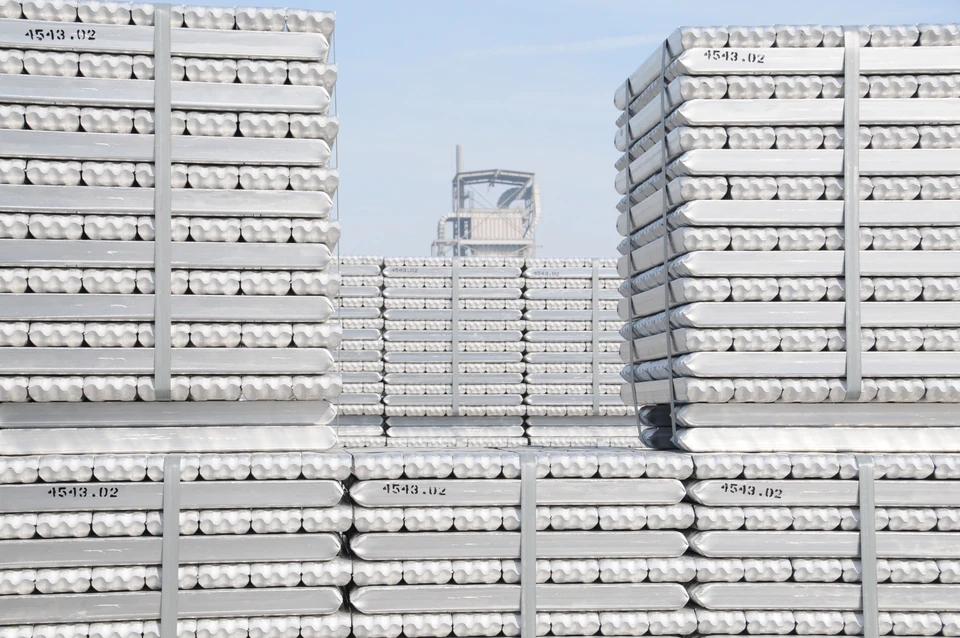
Image Credit: Albasmelter / Wikimedia Commons · CC BY-SA 4.0

A357.0 is a heat-treatable Al-Si-Mg casting alloy specified with 6.5–7.5% silicon, 0.40–0.70% magnesium, and a controlled 0.04–0.07% beryllium addition. It is intended for sand and permanent-mold structural castings where low mass, good corrosion resistance, pressure integrity, and high heat-treated strength are important. Its higher magnesium content distinguishes it from A356-type alloys by enabling stronger Mg2Si precipitation during aging. A357.0 is commonly selected for quality-critical aerospace, transportation, pump, and housing components, provided melt cleanliness, feeding, and heat treatment are carefully controlled.
| Chemical Composition wt.% | ||
|---|---|---|
| Element | Min | Max |
| Silicon | 6.5 | 7.5 |
| Iron | — | 0.20 |
| Copper | — | 0.20 |
| Manganese | — | 0.10 |
| Magnesium | 0.40 | 0.70 |
| Zinc | — | 0.10 |
| Titanium | 0.04 | 0.20 |
| Beryllium | 0.04 | 0.07 |
| Other elements, each | — | 0.05 |
| Other elements, total | — | 0.15 |
| Aluminum | Remainder | |
Composition notes
- Other elements, each: Maximum for each unspecified element.
- Other elements, total: Maximum total of unspecified elements.
Registered Aluminum Association chemical-composition limits for A357.0 castings (S&P: sand and permanent mold). Values are mass percent. Aluminum is the remainder. “Other, each” and “Other, total” are impurity limits; beryllium requires appropriate occupational hygiene and melt-handling controls.
Reported ranges below apply specifically to A357.0 investment castings in the T6 condition unless otherwise stated. Actual casting properties depend strongly on section thickness, soundness, heat treatment, and test location.
Use the button to switch between Metric and US Customary units.
| Physical Properties | Metric |
|---|---|
| Density | 2.65–2.71 × 10³ kg/m³ |
| Mechanical Properties | Metric |
| Young’s modulus | 70.6–73.4 GPa |
| Tensile strength | 291–322 MPa |
| Yield strength (elastic limit) | 229–254 MPa |
| Elongation | 3.3–4.0 % strain |
| Vickers hardness | 96–110 HV |
| Fatigue strength at 10⁷ cycles | 95.9–98.1 MPa |
| Thermal Properties | Metric |
| Melting range | 549–626 °C |
| Thermal conductivity | 150–160 W/m·°C |
| Specific heat capacity | 944–982 J/kg·°C |
| Coefficient of thermal expansion | 21.3–22.1 µm/m·°C |
| Electrical Properties | Metric |
| Electrical resistivity | 3.7–5.8 µΩ·cm |
| Electrical conductivity | 29.7–46.6 % IACS |
Test conditions & data notes
- Density: Investment cast, T6
- Young’s modulus: Investment cast, T6
- Tensile strength: Investment cast, T6
- Yield strength (elastic limit): Investment cast, T6
- Elongation: Investment cast, T6
- Vickers hardness: Investment cast, T6
- Fatigue strength at 10⁷ cycles: Investment cast, T6
- Melting range: Investment cast, T6 data page
- Thermal conductivity: Investment cast, T6
- Specific heat capacity: Investment cast, T6
- Coefficient of thermal expansion: Investment cast, T6
- Electrical resistivity: Investment cast, T6
- Electrical conductivity: Investment cast, T6
Material Conditions & Tempers
A357.0 develops its principal strength after solution heat treatment, quenching, and artificial aging. The applicable temper and property requirements should be specified with the casting process, section size, quality level, and governing procurement standard.
| Condition | Tensile Strength | Yield / Proof Strength | Notes |
|---|---|---|---|
| T6 | 291–322 MPa | 229–254 MPa | Solution heat-treated and artificially aged condition. Reported investment-casting data show 3.3–4.0% elongation and 96–110 HV. Values are reported for investment cast A357.0-T6 and are not universal minimum requirements for every casting specification. |
| T61 | A controlled solution heat-treated and artificially aged condition used within the 357 alloy family where a specified strength–ductility balance is required. Confirm required mechanical-property minima directly in the applicable casting specification. | ||
| As-cast | Unheat-treated casting condition, used where the design does not require the precipitation-hardened strength available from T6-type treatment. Mechanical properties vary substantially with mold process, cooling rate, section size, and casting soundness. |
Advantages & Limitations
| Advantages | Limitations |
|---|---|
|
|
Processing & Fabrication
| Process | Description |
|---|---|
| Sand, permanent-mold, and investment casting | A357.0 is used for quality-focused casting processes that can produce controlled solidification and sound sections. Design gating, risers, chills, and section transitions to promote feeding and minimize shrinkage porosity. |
| Melt practice | Control hydrogen, oxide films, and iron-bearing contamination carefully. The beryllium-containing chemistry requires documented safe handling, ventilation, and dust-control procedures during melt and finishing operations. |
| Heat treatment | T6 processing consists of solution heat treatment, a rapid quench, and artificial aging. The 357 family is solution treated near 1,000 °F according to the cited foundry guidance; establish the exact cycle and quench limits using the governing specification and casting qualification. |
| Machining | Machine after casting stabilization or final heat treatment when dimensional control is important. Provide rigid fixturing for thin or complex castings, and account for local porosity risk when machining pressure boundaries. |
| Welding and repair | Weld repair and joining must be qualified for the casting quality requirement. Welding can locally alter the T6 precipitation condition; post-weld heat treatment may be necessary where restored properties are required. |
Applications
A357.0 is most appropriate for cast components that combine lightweight construction with elevated static or cyclic loading, corrosion exposure, pressure containment, or complex geometry. Final suitability depends on casting quality class and validated properties in the critical section.
- Aerospace and defense structural castings: The alloy offers a favorable strength-to-weight ratio after T6 treatment and is used where controlled chemistry and premium casting quality justify the processing discipline.
- Wheels, space frames, and vehicle structural components: Low density reduces mass while heat treatment provides substantially greater strength than general-purpose Al-Si casting alloys.
- Pump, valve, meter, and fluid-system housings: Good castability and pressure-tightness potential support complex internal passages and housing geometry when porosity is controlled.
- Axle, differential, and transmission-related housings: The combination of stiffness, heat-treated strength, and corrosion resistance suits load-bearing transportation castings.
- Electronic and industrial equipment enclosures: The alloy combines structural rigidity with useful thermal conductivity for housings that also manage heat.
Standards & Designations
| Designation | Value | Description |
|---|---|---|
| Aluminum Association | A357.0 | Registered casting-alloy designation; the supplied AA Pink Sheets record identifies A357.0 as an S&P (sand and permanent mold) composition. |
| UNS | A13570 | UNS designation reported for A357.0. |
| ASTM | ASTM B108 | Listed by the cited A357.0 investment-casting source among associated U.S. standards/designations; verify product scope and revision before procurement. |
| ASTM | ASTM B686 | Listed by the cited A357.0 investment-casting source among associated U.S. standards/designations; verify applicable casting class and property requirements. |
Frequently Asked Questions
How does A357.0 differ from A356?
Both are Al-Si-Mg casting alloys with a similar silicon range, but A357.0 has a higher specified magnesium range of 0.40–0.70% and includes 0.04–0.07% beryllium. The additional magnesium supports higher precipitation-hardening response after T6 treatment, while demanding closer melt and process control.
Can A357.0 be used in a T6 condition?
Yes. T6 is a common condition for A357.0: solution heat treatment, quenching, and artificial aging develop the alloy’s strength. One reported investment-cast T6 dataset gives tensile strength of 291–322 MPa and yield strength of 229–254 MPa; required values must still be taken from the applicable part specification.
Why is beryllium specified in A357.0?
A357.0 contains 0.04–0.07% beryllium. In this alloy family it is used to help control magnesium oxidation in the melt and influence iron-bearing phases. Because beryllium-containing fumes and dust present health hazards, foundry and finishing operations require appropriate industrial-hygiene controls.
References & Data Notes
- (n.d.). Aluminum Association — Designations and Chemical Composition Limits for Aluminum Alloys in the Form of Castings and Ingot (Pink Sheets 2025). https://www.aluminum.org/sites/default/files/2025-10/Pink%20Sheets%202025.pdf
- (n.d.). Modulus Metal — Aluminum, A357.0, investment cast, T6. https://www.modulusmetal.com/aluminum-a357-0-investment-cast-t6
- (n.d.). LeClaire Manufacturing — A357 Aluminum Alloy: Properties, E357, and F357 Explained. https://www.leclairemfg.com/blog/a357-aluminum-alloy
- (n.d.). PartMFG — A357 Aluminum Properties, Casting and Composition Guide. https://www.partmfg.com/a357-aluminum-alloy
Chemical composition is from the Aluminum Association registered A357.0 casting record. Property ranges are source-reported values for investment-cast A357.0-T6 and should not be used as universal design allowables or substituted for a drawing, ASTM/AMS requirement, or casting qualification.