 MetalsAlloy
5183 Aluminum
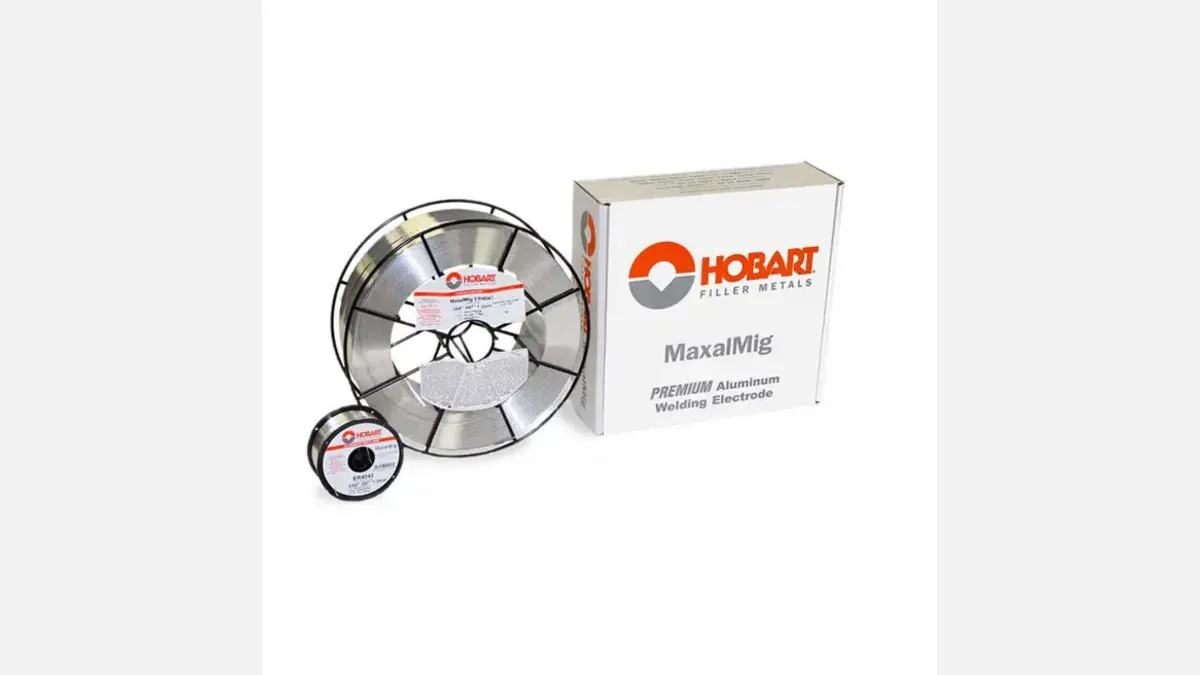
Image Credit: hobartbrothers.com
5183 Aluminum (AA 5183) is a non-heat-treatable Al-Mg-Mn alloy principally supplied as ER5183 welding wire or R5183 rod. Its relatively high magnesium content was developed to produce high-strength, corrosion-resistant welds in 5083 and related high-magnesium aluminum alloys, particularly for marine and structural fabrication. The alloy combines good seawater-corrosion performance with favorable weld-metal strength and fracture toughness. Published strength data must be read carefully: values for 5183 filler, deposited weld metal, and a completed welded joint are not interchangeable, and depend on base metal, joint design, process, and welding procedure.
| Chemical Composition wt.% | ||
|---|---|---|
| Element | Min | Max |
| Silicon | — | 0.40 |
| Iron | — | 0.40 |
| Copper | — | 0.10 |
| Manganese | 0.50 | 1.0 |
| Magnesium | 4.3 | 5.2 |
| Chromium | 0.05 | 0.25 |
| Zinc | — | 0.25 |
| Titanium | — | 0.15 |
| Beryllium | — | 0.0008 |
| Other elements, each | — | 0.05 |
| Other elements, total | — | 0.15 |
| Aluminum | Remainder | |
Composition notes
- Beryllium: Maximum reported in the Aufhauser 5183 filler-metal composition table
- Aluminum: Balance.
Registered AA 5183 wrought-alloy limits are shown in mass percent; aluminum is the remainder. The registered table includes a footnote associated with 5183; a filler-metal supplier separately reports beryllium at 0.0008% maximum. This page retains that limit as a supplier-reported filler-metal restriction rather than treating it as an independently verified general wrought-product limit.
Physical values below are reported for 5183 filler metal. Mechanical values are typical results for completed GMAW groove-joint welds made using 5183, not intrinsic properties of an unspecified 5183 sheet, wire, or deposited weld-metal condition.
Use the button to switch between Metric and US Customary units.
| Physical Properties | Metric |
|---|---|
| Density at 68°F | 0.096 lb/in³2.66 g/cm³ |
| Calculated nominal density | 2.66 × 10³ kg/m³2.66 g/cm³ |
| Mechanical Properties | Metric |
| Tensile Strength (5183 GMAW weld on 5083-O) | 40 ksi |
| Yield Strength (5183 GMAW weld on 5083-O) | 18 ksi |
| Elongation (5183 GMAW weld on 5083-O) | 16 % |
| Tensile Strength (5183 GMAW weld on 7039-T61) | 47 ksi |
| Yield Strength (5183 GMAW weld on 7039-T61) | 32 ksi |
| Elongation (5183 GMAW weld on 7039-T61) | 14 % |
| Tensile Strength (5183 GMAW weld on 7039-T64) | 45 ksi |
| Yield Strength (5183 GMAW weld on 7039-T64) | 26 ksi |
| Elongation (5183 GMAW weld on 7039-T64) | 12 % |
| Thermal Properties | Metric |
| Melting Range | 579–638 °C |
Test conditions & data notes
- Density at 68°F: Reported for Aluminum 5183 filler metal at 68°F.
- Calculated nominal density: Calculated nominal density for active wrought alloy 5183.
- Melting Range: Reported for Aluminum 5183 filler metal.
- Tensile Strength (5183 GMAW weld on 5083-O): Typical as-welded GMAW groove-joint weld result; 5083-O base alloy.
- Yield Strength (5183 GMAW weld on 5083-O): Typical as-welded GMAW groove-joint weld result; 5083-O base alloy.
- Elongation (5183 GMAW weld on 5083-O): Typical as-welded GMAW groove-joint weld result; 5083-O base alloy.
- Tensile Strength (5183 GMAW weld on 7039-T61): Typical as-welded GMAW groove-joint weld result; 7039-T61 base alloy.
- Yield Strength (5183 GMAW weld on 7039-T61): Typical as-welded GMAW groove-joint weld result; 7039-T61 base alloy.
- Elongation (5183 GMAW weld on 7039-T61): Typical as-welded GMAW groove-joint weld result; 7039-T61 base alloy.
- Tensile Strength (5183 GMAW weld on 7039-T64): Typical as-welded GMAW groove-joint weld result; 7039-T64 base alloy.
- Yield Strength (5183 GMAW weld on 7039-T64): Typical as-welded GMAW groove-joint weld result; 7039-T64 base alloy.
- Elongation (5183 GMAW weld on 7039-T64): Typical as-welded GMAW groove-joint weld result; 7039-T64 base alloy.
Material Conditions & Tempers
5183 is commonly purchased as bare welding wire (ER5183) or welding rod (R5183), rather than specified as a conventional wrought sheet temper. The relevant condition for design is normally the qualified, as-welded joint or deposited weld metal. Procedure qualification is necessary because mechanical properties vary with base alloy, thickness, heat input, shielding gas, and joint geometry.
| Condition | Tensile Strength | Yield / Proof Strength | Notes |
|---|---|---|---|
| ER5183 | — | — | Bare aluminum welding electrode/wire classification used for gas-metal-arc welding applications. Do not assign a generic parent-material temper or joint strength to wire alone. |
| R5183 | — | — | Bare aluminum welding rod classification used for gas-tungsten-arc welding applications. Final weld properties depend on the qualified welding procedure and base metal. |
| As-welded GMAW joint | 40–47 ksi | 18–32 ksi | Typical reported groove-joint results using 5183 filler on specific 5083-O and 7039 base-metal conditions. This range combines distinct reported joint/base-alloy conditions; it is not a filler-metal specification. |
Advantages & Limitations
| Advantages | Limitations |
|---|---|
|
|
Processing & Fabrication
| Process | Description |
|---|---|
| GMAW / MIG welding | 5183 is widely used as wire for high-strength welds in 5083 and related high-magnesium base alloys. Use a qualified procedure with dry, clean filler and base-metal surfaces; the cited supplier’s parameter table is based on flat-position groove welds, a backing strip, and 100% argon shielding gas. |
| GTAW / TIG welding | R5183 rod may be used where TIG process control and access favor manual rod feeding. Select filler diameter, current, shielding, and joint preparation through procedure qualification rather than using weld-joint test values as universal settings. |
| Joint preparation and cleaning | Remove moisture, oil, and the tenacious aluminum oxide film immediately before welding. Good fit-up and appropriate heat-input control help reduce lack of fusion, distortion, and porosity in aluminum structures. |
| Post-weld treatment | Do not rely on precipitation-hardening heat treatment after welding. Where residual stress, distortion, or service environment is critical, establish any mechanical straightening, stress-relief approach, coating, or inspection plan for the complete welded assembly. |
Applications
5183 is selected primarily where the filler must preserve the strength and corrosion performance expected of welded high-magnesium aluminum structures. Its most established role is joining 5083 and comparable Al-Mg alloys in demanding fabricated equipment.
- Marine hulls, superstructures, and deck fabrications: High-magnesium weld metal offers strong joints and useful resistance to seawater exposure when paired with suitable marine base alloys and a qualified procedure.
- Offshore and coastal structures: The alloy was developed for high-strength, corrosion-exposed welds where fracture toughness and reliable as-welded performance matter.
- Aluminum tanks and pressure-containing fabrications: 5183 can support strong welded joints in high-magnesium aluminum construction, subject to applicable vessel codes and joint qualification.
- Cryogenic and low-temperature aluminum structures: Al-Mg weld fillers are commonly considered for tough welded aluminum construction; the actual base metal, consumable, and qualified low-temperature performance must be specified for the project.
- Structural repairs and fabrication using 5083-family alloys: It is an alternative to more common 5356 filler where higher as-welded strength is needed for compatible high-magnesium base material.
Standards & Designations
| Designation | Value | Description |
|---|---|---|
| Aluminum Association International Alloy Designation System | 5183 | Active registered wrought aluminum-alloy designation; composition limits are published in the Aluminum Association Teal Sheets. |
| AWS | ANSI/AWS A5.10 ER5183 and R5183 | Filler-metal classifications reported by the cited Aluminum 5183 supplier. |
| ISO designation cross-reference | AlMg4.5Mn0.7(A) | The Aluminum Association Teal Sheets cross-reference 5183 to this former ISO designation and note that ISO 209 references the Teal Sheets as normative designation information. |
Frequently Asked Questions
Is 5183 aluminum the same as 5083 aluminum?
No. 5183 and 5083 have related Al-Mg-Mn chemistries, but 5183 is widely used as a welding filler alloy while 5083 is a common structural base alloy. Their registered composition limits are not identical, and the material form and applicable specification must be stated.
When should ER5183 be considered instead of ER5356?
ER5183 is commonly chosen for welding 5083 and similar high-magnesium alloys when high as-welded joint strength is important. Filler selection must also consider the base alloy, service environment, cracking behavior, code requirements, and qualified welding procedure; it is not a blanket replacement for ER5356.
Can the listed GMAW strength values be used to design every 5183 weld?
No. The reported values are typical results for groove-joint welds on named 5083-O or 7039 temper base metals. A production weld can differ with base material, thickness, joint configuration, filler diameter, heat input, shielding gas, and acceptance standard, so use procedure-qualification and project-specific design data.
References & Data Notes
- (n.d.). The Aluminum Association, International Alloy Designations and Chemical Composition Limits for Wrought Aluminum and Wrought Aluminum Alloys, Teal Sheets (December 2025). https://www.aluminum.org/sites/default/files/2026-01/Teal%20Sheets%20December%202025.pdf
- (n.d.). Aufhauser Aluminum 5183 filler-metal data sheet. https://www.brazing.com/products/Welding_alloys/alloy5183.aspx
Composition limits are registered AA 5183 limits unless explicitly identified as a supplier-reported filler-metal restriction. Physical and mechanical data are limited to values visibly reported by the cited sources. In particular, the mechanical rows describe specific as-welded GMAW test joints and must not be represented as general properties of 5183 wire, rod, deposited weld metal, or plate.