 MetalsAlloy
4943 Aluminum
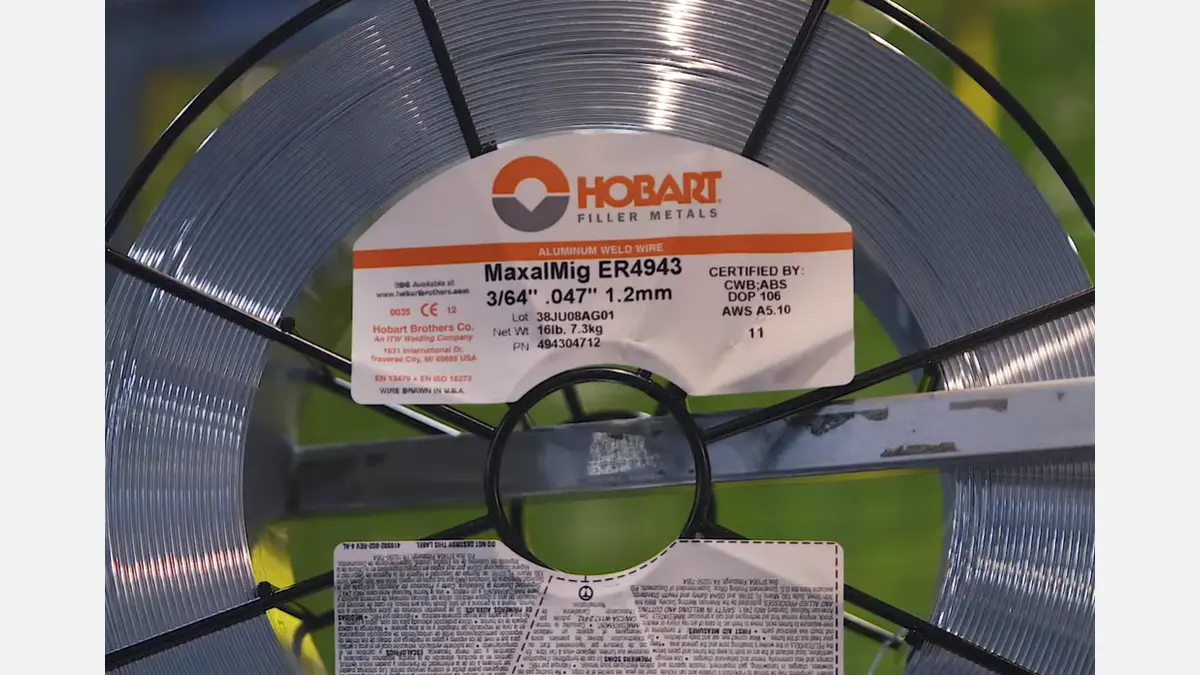
Image Credit: hobartbrothers.com

4943 Aluminum (AA 4943) is an active registered Al–Si–Mg alloy chiefly supplied as solid welding wire or rod, including ER4943 and R4943 filler metal. Its 5.0–6.0% silicon content provides a low-melting, fluid weld pool similar to 4043, while magnesium supports a stronger weld deposit and post-weld heat-treatment response. It is used for welding many 1xxx, 3xxx, 5xxx alloys containing less than 2.5% Mg, and 6xxx-series alloys. Published mechanical values below apply specifically to deposited weld metal in the as-welded condition, not to a generic wrought-product temper.
| Chemical Composition wt.% | ||
|---|---|---|
| Element | Min | Max |
| Silicon | 5.0 | 6.0 |
| Iron | — | 0.40 |
| Copper | — | 0.10 |
| Manganese | — | 0.05 |
| Magnesium | 0.10 | 0.50 |
| Zinc | — | 0.10 |
| Titanium | — | 0.15 |
| Beryllium | — | 0.0003 |
| Others, each | — | 0.05 |
| Others, total | — | 0.15 |
| Aluminum | Remainder | |
Composition notes
- Silicon: Registered composition limit.
- Iron: Registered composition limit.
- Copper: Registered composition limit.
- Manganese: Registered composition limit.
- Magnesium: Registered AA 4943 composition limit.
- Zinc: Registered composition limit.
- Titanium: Registered composition limit.
- Beryllium: Reported by Hobart as below 0.0003% for ER4943/R4943 weld-metal chemistry; not shown as a registered AA 4943 limit in the supplied register excerpt.
- Others, each: Registered composition limit.
- Others, total: Registered composition limit.
- Aluminum: Registered balance.
Registered Aluminum Association limits are shown for AA 4943. Aluminum is the remainder. Hobart’s ER4943/R4943 product data separately report beryllium below 0.0003% in weld-metal chemistry; this is retained as a filler-product datum rather than presented as an Aluminum Association registered limit. The Hobart product sheet lists a 0.30–0.50% Mg AWS filler-metal specification range, whereas the registered AA 4943 range is 0.10–0.50% Mg.
Values are source-reported for AA 4943 or ER4943/R4943 deposited weld metal. Tensile strength and the melting range are for Hobart Maxal 4943 filler metal; they must not be used as design values for an unspecified 4943 wrought-product form or temper.
| Physical Properties | Metric |
|---|---|
| Density (calculated nominal) | 2.68 × 10³ kg/m³ |
| Density (ER4943/R4943 filler product) | 0.097; 2.685 lb/in³; g/cm³ |
| Mechanical Properties | Metric |
| Tensile Strength (as-welded deposited weld metal) | 33,000; 228 psi; MPa |
| Thermal Properties | Metric |
| Melting Range (ER4943/R4943 filler product) | 1065–1175; 575–635 °F; °C |
| Electrical Properties | Metric |
| Electrical Conductivity (ER4943/R4943 filler product) | 41 % IACS |
Test conditions & data notes
- Density (calculated nominal): Active wrought alloy designation; Aluminum Association calculated nominal density.
- Density (ER4943/R4943 filler product): Hobart Maxal 4943 typical physical property.
- Tensile Strength (as-welded deposited weld metal): Typical ER4943/R4943 weld-metal result; Hobart states tests were welded and tested in accordance with AWS A5.10.
- Melting Range (ER4943/R4943 filler product): Hobart Maxal 4943 typical physical property.
- Electrical Conductivity (ER4943/R4943 filler product): Hobart Maxal 4943 typical physical property.
Material Conditions & Tempers
4943 is commonly marketed as ER4943 wire and R4943 rod rather than as a conventional sheet, plate, or extrusion temper. The supplied product data provide an as-welded deposited-metal tensile result. Heat treatment after welding may be used where the joint and base-metal heat-treatment practice permit it, but no standalone wrought-temper property table was supplied.
As-welded deposited weld metal: ER4943/R4943 weld deposit tested in accordance with the supplier’s AWS A5.10-referenced procedure. This is a typical weld-metal value, not a minimum strength for every joint configuration or an AA 4943 wrought temper.
Advantages & Limitations
| Advantages | Limitations |
|---|---|
|
|
Processing & Fabrication
| Process | Description |
|---|---|
| GMAW (MIG) | Hobart specifies direct-current electrode positive (DCEP) for GMAW. Use 100% argon or argon/helium shielding mixtures; the cited typical GMAW gas-flow range is 35–50 cfh (14–24 L/min). Clean oxide and contamination from the joint before welding. |
| GTAW (TIG) | Hobart specifies AC for GTAW with 100% argon or argon/helium mixtures; the cited typical GTAW gas-flow range is 20–30 cfh (10–14 L/min). ER4943 is available as wire and R4943 as rod. |
| Preheat and interpass control | Control cleaning, oxide removal, preheat, and interpass temperature as required by the base-metal type and thickness. The supplier notes that these procedure variables can be critical for aluminum welding. |
| Post-weld heat treatment | 4943 is intended for applications requiring post-weld heat treatment and aging. Establish the thermal cycle from the base-material specification and qualified welding procedure; do not assume that an as-welded deposit retains the properties of a heat-treated base alloy. |
Applications
4943 is selected where 4043-like weldability is desired but a stronger, potentially heat-treatable weld deposit is beneficial. Typical use is in aluminum fabrication rather than as a general-purpose wrought construction alloy.
- 6xxx-series structural and fabricated components: The alloy is intended for welding 6xxx base metals, combining fluid Al–Si filler behavior with higher typical deposited-metal tensile strength than conventional 4043-type practice.
- Post-weld heat-treated assemblies: 4943 is specifically promoted for weldments that will be solution heat treated and aged after welding, subject to a qualified assembly-level process.
- Automotive and motorcycle frames: The supplier lists automotive/motorcycle frames, where weld-pool fluidity, reduced distortion, and the opportunity for post-weld heat treatment can be useful.
- Selected 1xxx, 3xxx, and low-magnesium 5xxx fabrications: Hobart identifies these base-metal families, including 5052 as an example, for 5xxx alloys containing less than 2.5% Mg.
- Aerospace hardware: The supplier lists aerospace hardware; application remains dependent on the applicable engineering approval, filler specification, and qualified welding procedure.
Standards & Designations
| Designation | Value | Description |
|---|---|---|
| Aluminum Association | 4943 | Active registered wrought aluminum alloy designation; registered chemical-composition limits are published in the Aluminum Association Teal Sheets. |
| AWS | AWS A5.10 ER4943, R4943 | Hobart Maxal 4943 solid wire and rod are listed as conforming to these filler-metal classifications. |
| ASME | SFA 5.10 ER4943, R4943 | Listed by the Hobart product data as a conformance. |
| EN ISO | EN ISO 18273-S Al 4943 (AlSi5Mg) | Listed by Hobart as a DB designation for the product. |
| ASME Boiler and Pressure Vessel Code | F23 filler-metal group | The American Welding Society article states that 4943 has been designated as a Group F23 filler metal by ASME Boiler and Pressure Vessel Code. |
Frequently Asked Questions
How does 4943 differ from 4043 aluminum filler metal?
Both are Al–Si fillers with similar fluid weld-pool behavior, but 4943 also contains magnesium. This supports a higher-strength deposited weld metal and makes 4943 suitable for post-weld heat-treatment-and-aging applications when the full joint procedure is qualified.
What tensile strength can be expected from 4943 weld metal?
Hobart reports a typical as-welded tensile strength of 33,000 psi (228 MPa) for its ER4943/R4943 weld metal. Actual joint strength depends on base metal, joint geometry, dilution, shielding, welding parameters, and any post-weld thermal treatment.
Can 4943 be used to weld 5052?
The Hobart data list 5xxx base metals containing less than 2.5% magnesium, with 5052 given as an example. Filler choice should still be verified against the specific service environment and corrosion, ductility, and strength requirements of the weldment.
References & Data Notes
- (n.d.). Aluminum Association, International Alloy Designations and Chemical Composition Limits for Wrought Aluminum and Wrought Aluminum Alloys (Teal Sheets), revised December 2025. https://www.aluminum.org/sites/default/files/2026-01/Teal%20Sheets%20December%202025.pdf
- (n.d.). Hobart Maxal 4943 product datasheet. https://www.hobartbrothers.com/wp-content/uploads/hobart-catalog/datasheets/Hobart_Maxal_4943-1.pdf
- (n.d.). American Welding Society, Filler Metal 4943: A Fresh Beginning in Welding. https://www.aws.org/magazines-and-media/welding-journal/4943-filler-metal-a-fresh-beginning
Chemical limits are registered AA 4943 values unless explicitly noted otherwise. Numerical mechanical and filler physical data are typical supplier data for ER4943/R4943 deposited weld metal or filler product, not guaranteed values or generalized wrought-alloy properties.