 MetalsAlloy
3105 Aluminum
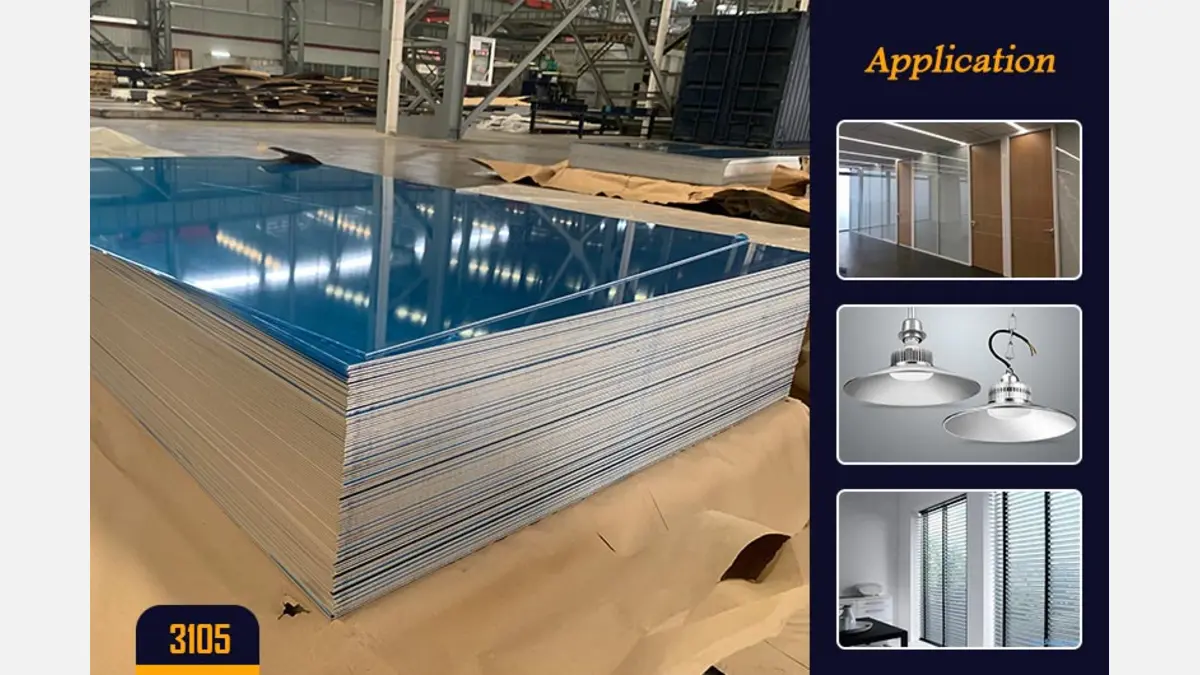
Image Credit: chalcoaluminum.com
3105 Aluminum (AA 3105, UNS A93105) is a wrought 3000-series aluminum–manganese alloy commonly supplied as sheet, strip, and coil. Its manganese and magnesium additions provide higher strength than commercially pure 1000-series aluminum while retaining useful corrosion resistance, formability, and weldability. It is a non-heat-treatable alloy: strength is developed principally by cold work and selected H tempers rather than precipitation heat treatment. The alloy is widely used for painted or bare architectural sheet, siding, sign stock, mobile-home components, and general sheet-metal parts where moderate strength and economical fabrication are important.
| Chemical Composition wt.% | ||
|---|---|---|
| Element | Min | Max |
| Silicon | — | 0.60 |
| Iron | — | 0.70 |
| Copper | — | 0.30 |
| Manganese | 0.30 | 0.80 |
| Magnesium | 0.20 | 0.80 |
| Chromium | — | 0.20 |
| Zinc | — | 0.40 |
| Titanium | — | 0.10 |
| Other elements, each | — | 0.05 |
| Other elements, total | — | 0.15 |
| Aluminum | Remainder | |
Registered chemical-composition limits for wrought alloy 3105 are in weight percent. Values are maximum unless a range is shown. Aluminum is the remainder. The registered designation is distinct from 3105A and 3105B.
Reported values are nominal physical data or ASTM B209/ASME SB209 mechanical requirements for 3105 sheet in the stated temper and thickness range. Mechanical requirements should be checked against the governing product specification and ordered dimensions.
Use the button to switch between Metric and US Customary units.
| Physical Properties | Metric |
|---|---|
| Density | 2.72 × 10³ kg/m³2.72 g/cm³ |
| Mechanical Properties | Metric |
| Modulus of Elasticity | 12.1 × 10⁶ psi |
| Yield Strength (H14, 0.017–0.080 in) | 18.0 min ksi |
| Tensile Strength (H14, 0.017–0.080 in) | 22.0–29.0 ksi |
Test conditions & data notes
- Density: Calculated nominal density for active wrought alloy 3105
- Modulus of Elasticity: Alloy 3105 physical-property data
- Yield Strength (H14, 0.017–0.080 in): Strain-hardened H14 sheet; ASTM B209 and ASME SB209 requirements
- Tensile Strength (H14, 0.017–0.080 in): Strain-hardened H14 sheet; ASTM B209 and ASME SB209 requirements
Material Conditions & Tempers
Because 3105 is not heat treatable for strengthening, supplied strength depends mainly on annealing and cold-work temper. O temper is selected where maximum forming latitude is needed. H1x tempers indicate strain hardening; increasing the final digit generally increases strength while reducing formability. Confirm the available temper, thickness range, and property requirements with the applicable sheet or strip specification.
| Condition | Tensile Strength | Yield / Proof Strength | Notes |
|---|---|---|---|
| O | Annealed condition with the greatest ductility for forming operations. Numerical values vary with product form and thickness. | ||
| H12 | Quarter-hard strain-hardened condition offering a modest increase in strength over O temper. Suitable where some forming capability is still required. | ||
| H14 | 22.0–29.0 ksi | 18.0 ksi minimum | Half-hard strain-hardened sheet condition balancing stiffness and formability. Reported ASTM B209/ASME SB209 requirements apply to 0.017–0.080 in sheet. |
| H16 | Three-quarter-hard strain-hardened condition for applications needing increased resistance to denting or distortion. Use when forming severity is lower than for O or H14 material. | ||
| H18 | Full-hard strain-hardened condition with high strength for thin sheet and coil applications. Reduced ductility makes it less suitable for severe forming. |
Advantages & Limitations
| Advantages | Limitations |
|---|---|
|
|
Processing & Fabrication
| Process | Description |
|---|---|
| Cold forming and roll forming | 3105 is commonly processed from sheet or coil by bending, profiling, stamping, and roll forming. Select O or a lighter H temper for severe shapes; use higher H tempers where dimensional stiffness is more important than deep-forming capacity. |
| Welding | The alloy has good weldability. Remove oil, oxide, and coating from the joint area, and qualify filler metal, shielding gas, joint configuration, and post-weld corrosion requirements for the specific service. |
| Painting and coating | 3105 is frequently used as painted or prepainted sheet. Surface cleaning and pretreatment should be matched to the selected liquid, powder, or coil-coating system to obtain reliable adhesion and outdoor durability. |
| Cutting and shearing | Sheet and coil can be slit, sheared, punched, or blanked efficiently. Control tool clearance, burr direction, and edge quality where exposed architectural edges or subsequent forming are required. |
Applications
3105 is particularly useful in rolled sheet applications that need more strength than commercially pure aluminum but do not require a heat-treatable structural alloy. Its corrosion resistance, formability, and suitability for painted coil make it a practical material for building products and light-gauge fabricated components.
- Residential siding and soffit: Light weight, atmospheric corrosion resistance, and compatibility with painted sheet systems support long exterior service.
- Roofing, trim, and rainwater goods: Coil availability and roll-forming capability enable continuous architectural profiles, flashing, fascia, and gutters.
- Sign blanks and sign panels: The alloy provides a flat, corrosion-resistant substrate that can be painted, coated, or fabricated into formed sign components.
- Mobile-home and recreational-vehicle panels: Moderate strength and good formability suit lightweight exterior and interior sheet components.
- General sheet-metal fabrications: 3105 offers an economical balance of strength, weldability, and forming behavior for covers, housings, ducts, and trim.
Standards & Designations
| Designation | Value | Description |
|---|---|---|
| Aluminum Association | 3105 | Active registered international designation for a wrought aluminum alloy. |
| UNS | A93105 | UNS designation used for aluminum alloy 3105. |
| ASTM / ASME | ASTM B209 / ASME SB209 | The supplier data identify these specifications for 3105 sheet composition limits and H14 mechanical-property requirements; verify the revision and applicable product scope. |
| International designation cross reference | AlMn0.5Mg0.5 | Former ISO designation shown for 3105 in the Aluminum Association cross-reference table. |
Frequently Asked Questions
Is 3105 aluminum heat treatable?
No. Alloy 3105 is not hardened by solution heat treatment and artificial aging. Its strength is controlled chiefly by composition and cold work, so O and H tempers are used to balance forming ability and strength.
What is the practical difference between 3105 and 3003 aluminum?
Both are non-heat-treatable 3xxx sheet alloys, but 3105 has specified magnesium of 0.20–0.80% and lower manganese of 0.30–0.80%, whereas 3003 is principally manganese strengthened. 3105 is commonly selected for architectural coil products and applications needing strength beyond 1100 or 3003-class sheet; final selection should use the required temper and product-specification properties.
Can 3105 be used outdoors?
Yes, it is widely used for siding, trim, and other architectural sheet because aluminum forms a protective oxide film and 3105 has good corrosion resistance. For long outdoor exposure, coating selection, cut-edge treatment, fastener isolation, drainage, and local atmosphere should be considered as part of the finished-system design.
References & Data Notes
- (n.d.). The Aluminum Association, International Alloy Designations and Chemical Composition Limits for Wrought Aluminum and Wrought Aluminum Alloys (Teal Sheets), December 2025. https://www.aluminum.org/sites/default/files/2026-01/Teal%20Sheets%20December%202025.pdf
- (n.d.). Rolled Metal Products, Aluminum 3105 (UNS A93105) in Coil Form. https://rolledmetalproducts.com/aluminum-3105
- (n.d.). Rolled Metal Products, Aluminum 3105 Data Sheet. https://www.rolledmetalproducts.com/wp-content/uploads/docs/Aluminum_3105_Data_Sheet_web.pdf
Composition is taken from the Aluminum Association registered wrought-alloy limits. Density is the Aluminum Association calculated nominal value. Numerical mechanical values shown are limited to the reported H14 sheet requirements; properties depend on temper, thickness, product form, and governing specification.