 MetalsAlloy
3103 Aluminum
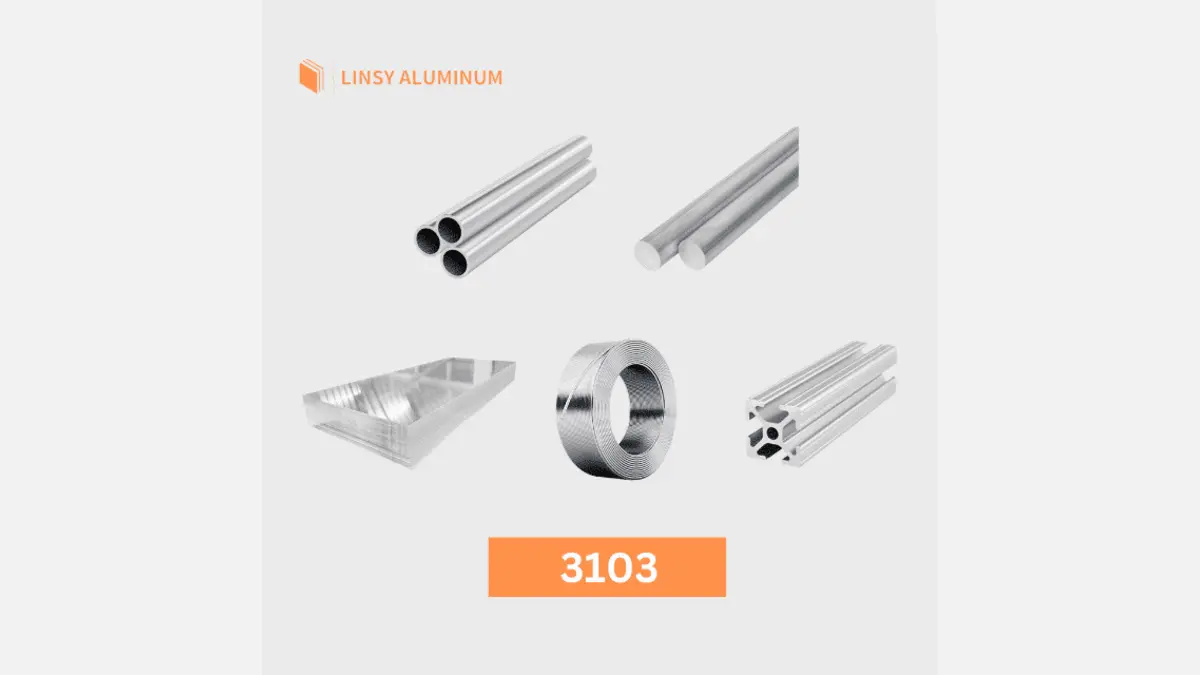
Image Credit: premiumalu.com
3103 Aluminum (AA 3103) is a registered wrought aluminum–manganese alloy in the 3xxx series. Its 0.9–1.5% manganese addition provides higher strength than commercially pure 1xxx aluminum while retaining very good formability, weldability, and resistance to atmospheric corrosion. It is a non-heat-treatable alloy: strength is developed principally by cold work and selected H tempers. Sheet is widely used where lightweight, formed parts and dependable corrosion performance are more important than high structural strength, including heat-transfer equipment, kitchenware, and general fabricated sheet components.
| Chemical Composition wt.% | ||
|---|---|---|
| Element | Min | Max |
| Silicon | — | 0.50 |
| Iron | — | 0.70 |
| Copper | — | 0.10 |
| Manganese | 0.90 | 1.50 |
| Magnesium | — | 0.30 |
| Chromium | — | 0.10 |
| Zinc | — | 0.20 |
| Zirconium + Titanium | — | 0.10 |
| Other elements, each | — | 0.05 |
| Other elements, total | — | 0.15 |
| Aluminum | Remainder | |
Composition notes
- Zirconium + Titanium: Combined maximum (Zr+Ti)
Registered chemical-composition limits for wrought 3103, in weight percent. Aluminum is the remainder. The registered limit is a combined maximum of 0.10% zirconium plus titanium (Zr+Ti); separate Zr and Ti limits are not stated in the supplied registered record.
Values below are supplier-reported reference values for 3103 sheet. Mechanical values are stated for the cited sheet thickness ranges and temper; they should not be used as universal design minima for all product forms.
Use the button to switch between Metric and US Customary units.
| Physical Properties | Metric |
|---|---|
| Density | 2.73 g/cm³2.73 g/cm³ |
| Mechanical Properties | Metric |
| Modulus of Elasticity | 69.5 GPa |
| Tensile Strength (O temper sheet) | 90–130 MPa |
| 0.2% Proof Strength (O temper sheet) | 35 MPa |
| Elongation A50 mm (O temper sheet) | 21 % |
| Brinell Hardness (O temper sheet) | 27 HBW |
| Tensile Strength (H14 sheet) | 140–180 MPa |
| 0.2% Proof Strength (H14 sheet) | 120 MPa |
| Elongation A50 mm (H14 sheet) | 3 % |
| Brinell Hardness (H14 sheet) | 45 HBW |
| Tensile Strength (H16 sheet) | 160–200 MPa |
| 0.2% Proof Strength (H16 sheet) | 145 MPa |
| Elongation A50 mm (H16 sheet) | 2 % |
| Brinell Hardness (H16 sheet) | 51 HBW |
| Tensile Strength (H26 sheet) | 160–200 MPa |
| 0.2% Proof Strength (H26 sheet) | 135 MPa |
| Elongation A50 mm (H26 sheet) | 3 % |
| Brinell Hardness (H26 sheet) | 50 HBW |
| Thermal Properties | Metric |
| Melting Range | 640–655 °C |
| Electrical Properties | Metric |
| Electrical Conductivity | 50.5 % IACS |
Test conditions & data notes
- Density: Reference physical property
- Melting Range: Reference physical property
- Electrical Conductivity: 20 °C
- Modulus of Elasticity: Reference physical property
- Tensile Strength (O temper sheet): Sheet thickness 1.5–3 mm; typical value
- 0.2% Proof Strength (O temper sheet): Sheet thickness 1.5–3 mm; typical value
- Elongation A50 mm (O temper sheet): Sheet thickness 1.5–3 mm; typical value
- Brinell Hardness (O temper sheet): Sheet thickness 1.5–3 mm; typical value
- Tensile Strength (H14 sheet): Sheet thickness 1.5–3 mm; typical value
- 0.2% Proof Strength (H14 sheet): Sheet thickness 1.5–3 mm; typical value
- Elongation A50 mm (H14 sheet): Sheet thickness 1.5–3 mm; typical value
- Brinell Hardness (H14 sheet): Sheet thickness 1.5–3 mm; typical value
- Tensile Strength (H16 sheet): Sheet thickness 1.5–4 mm; typical value
- 0.2% Proof Strength (H16 sheet): Sheet thickness 1.5–4 mm; typical value
- Elongation A50 mm (H16 sheet): Sheet thickness 1.5–4 mm; typical value
- Brinell Hardness (H16 sheet): Sheet thickness 1.5–4 mm; typical value
- Tensile Strength (H26 sheet): Sheet thickness 1.5–4 mm; typical value
- 0.2% Proof Strength (H26 sheet): Sheet thickness 1.5–4 mm; typical value
- Elongation A50 mm (H26 sheet): Sheet thickness 1.5–4 mm; typical value
- Brinell Hardness (H26 sheet): Sheet thickness 1.5–4 mm; typical value
Material Conditions & Tempers
3103 is not strengthened by solution heat treatment and aging. Its O and H tempers describe annealed or strain-hardened material, allowing the balance of forming latitude and sheet strength to be selected for the part.
| Condition | Tensile Strength | Yield / Proof Strength | Notes |
|---|---|---|---|
| O | 90–130 MPa | 35 MPa | Annealed sheet condition, offering the greatest ductility of the listed tempers for demanding forming operations. Supplier typical values for 1.5–3 mm sheet; A50 elongation 21%. |
| H14 | 140–180 MPa | 120 MPa | Half-hard strain-hardened temper and a commonly supplied condition for general sheet fabrication. Supplier typical values for 1.5–3 mm sheet; A50 elongation 3%. |
| H16 | 160–200 MPa | 145 MPa | Three-quarter-hard strain-hardened sheet for applications needing greater resistance to permanent deformation than H14. Supplier typical values for 1.5–4 mm sheet; A50 elongation 2%. |
| H26 | 160–200 MPa | 135 MPa | Strain-hardened and partially annealed temper, providing a useful compromise between strength and formability. Supplier typical values for 1.5–4 mm sheet; A50 elongation 3%. |
Advantages & Limitations
| Advantages | Limitations |
|---|---|
|
|
Processing & Fabrication
| Process | Description |
|---|---|
| Forming | Use O temper where deep drawing, spinning, or tight formed shapes demand maximum ductility. H14 is appropriate for many less severe bends and general presswork; harder tempers trade forming reserve for strength. |
| Welding | 3103 sheet has very good weldability. Select filler metal, joint preparation, and procedure qualification for the service environment and the joining alloy; welding locally removes cold-work strength in the heat-affected zone. |
| Machining | This alloy is generally more suited to forming than to high-production precision machining. Use sharp tooling and workholding that limits distortion of thin sheet. |
| Heat treatment | Do not specify precipitation hardening for 3103. Annealing may be used by the producer or fabricator to restore formability, but any thermal cycle should be qualified because it changes the strain-hardened temper. |
| Surface preparation | Clean lubricant and surface contamination before welding, bonding, painting, or conversion coating. For decorative or protective finishes, confirm pretreatment compatibility with the intended coating system. |
Applications
3103 is selected for fabricated sheet and heat-transfer work that benefits from corrosion resistance, weldability, and greater strength than pure aluminum. Final temper should reflect the severity of forming and the stiffness required in service.
- Heat exchangers and heating/cooling equipment: The alloy combines good formability and weldability with atmospheric-corrosion resistance, making it suitable for formed and joined heat-transfer sheet parts.
- Kitchen components and cookware sheet: Its low density, corrosion resistance, and ability to be rolled and formed make it useful for non-structural kitchen components.
- General fabricated sheet-metal parts: H14 and related tempers provide a practical strength/formability balance for covers, housings, panels, and formed enclosures.
- Aerospace non-critical components: Low weight and sheet-forming capability support appropriate non-critical fabricated parts where the applicable specification permits 3103; it is not intended for highly loaded primary structure.
Standards & Designations
| Designation | Value | Description |
|---|---|---|
| Aluminum Association / International Alloy Designation System | 3103 | Active registered wrought aluminum-alloy designation; the registered composition is published in the Aluminum Association Teal Sheets. |
| UNS | A93103 | UNS number identified for a cited 3103 foil/sheet product. |
| BS EN | BS EN 573; BS EN 485 | The cited 3103 sheet datasheet identifies these alloy-composition and sheet product-standard families. |
| ISO cross-reference | AlMn1 | The Aluminum Association cross-reference table lists 3103 as AlMn1 for the former ISO designation context. |
Frequently Asked Questions
Is 3103 aluminum heat treatable?
No. 3103 is a non-heat-treatable 3xxx alloy. Its useful strength changes are obtained mainly by strain hardening, represented by H tempers, rather than by a solution-treatment and aging cycle.
What is the difference between 3103 and 3003 aluminum?
Both are aluminum–manganese wrought alloys with good corrosion resistance and formability. The registered 3103 composition has 0.90–1.50% manganese and permits up to 0.30% magnesium, whereas the registered 3003 composition listed by the Aluminum Association has 1.0–1.5% manganese and 0.05–0.20% copper. They should therefore be specified and certified as their individual grades, not assumed interchangeable.
Which 3103 temper is best for forming?
O temper is the listed condition with the highest elongation and is normally the first choice for severe drawing or complex forming. H14 offers more strength for general fabrication, while H16 and H26 have lower ductility and are better reserved for less demanding forming geometries.
References & Data Notes
- (n.d.). The Aluminum Association, International Alloy Designations and Chemical Composition Limits for Wrought Aluminum and Wrought Aluminum Alloys (Teal Sheets), December 2025. https://www.aluminum.org/sites/default/files/2026-01/Teal%20Sheets%20December%202025.pdf
- (n.d.). Smiths Advanced Metals, 3103 Aluminium Sheet datasheet. https://www.smithsadvanced.com/assets/pdf/3103-aluminium-sheet.pdf
- (n.d.). Goodfellow, 3103 Aluminum Foil/Sheet technical data. https://www.goodfellow.com/usa/technical_data/pdf/download?sku=1000238924
Composition values are registered limits from the Aluminum Association. Physical and mechanical values are supplier-reported reference data for specified 3103 sheet tempers and thickness ranges, not a replacement for the applicable product specification or mill test certificate.