 MetalsAlloy
2014A Aluminum
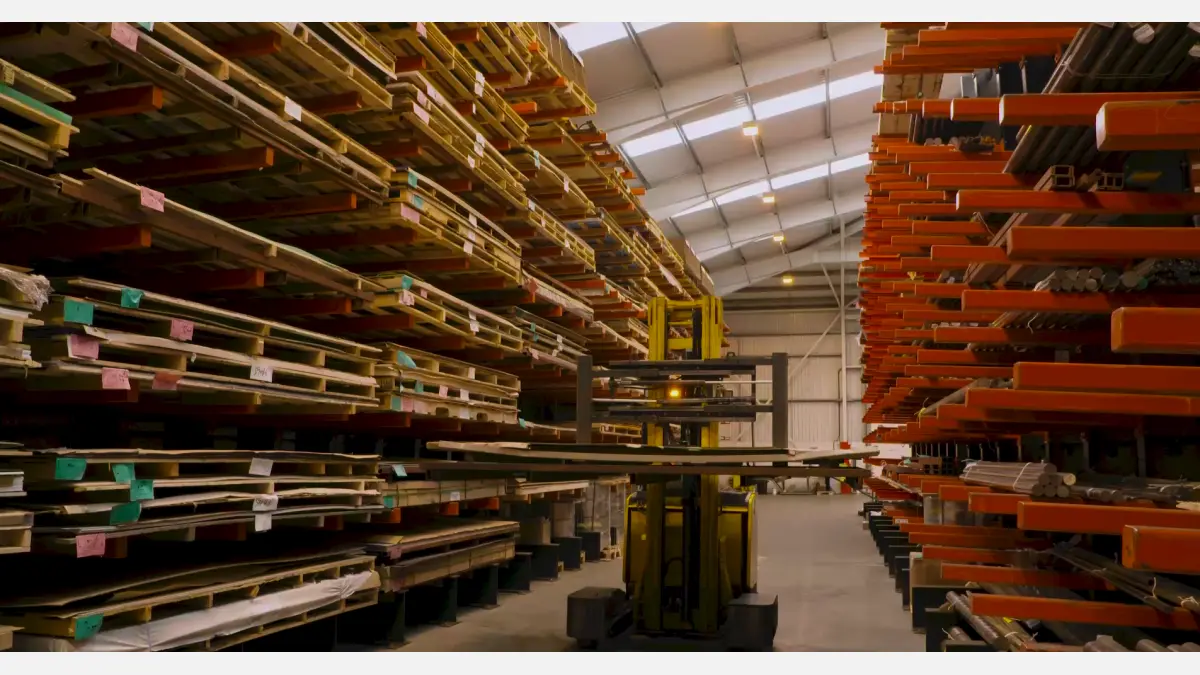
Image Credit: rightonblackburns.co.uk
2014A Aluminum (AA 2014A) is a registered wrought Al-Cu-Si-Mg alloy in the 2000 series. Its 3.9–5.0% copper content enables substantial strengthening by solution heat treatment and artificial aging, while silicon and magnesium support its high-strength response. It is commonly supplied as extruded bar, tube, and profile in the stress-relieved T6511 condition for demanding machined or structural parts. Compared with corrosion-resistant aluminum alloys, 2014A prioritizes strength and machinability; unprotected use in wet or salt-bearing environments requires careful corrosion protection.
| Chemical Composition wt.% | ||
|---|---|---|
| Element | Min | Max |
| Silicon | 0.50 | 0.90 |
| Iron | — | 0.50 |
| Copper | 3.9 | 5.0 |
| Manganese | 0.40 | 1.20 |
| Magnesium | 0.20 | 0.80 |
| Chromium | — | 0.10 |
| Nickel | — | 0.10 |
| Zinc | — | 0.25 |
| Titanium | — | 0.15 |
| Titanium + Zirconium | — | 0.20 |
| Other, each | — | 0.05 |
| Other, total | — | 0.15 |
| Aluminum | Remainder | |
Composition notes
- Silicon: Registered composition limit, mass %.
- Iron: Registered composition limit, mass %.
- Copper: Registered composition limit, mass %.
- Manganese: Registered composition limit, mass %.
- Magnesium: Registered composition limit, mass %.
- Chromium: Registered composition limit, mass %.
- Nickel: Registered composition limit, mass %.
- Zinc: Registered composition limit, mass %.
- Titanium: Registered composition limit, mass %.
- Titanium + Zirconium: Combined maximum, mass %.
- Other, each: Maximum for each unspecified element, mass %.
- Other, total: Maximum total of unspecified elements, mass %.
- Aluminum: Registered balance.
Registered composition limits are mass percent for wrought 2014A. The Aluminum Association limit for titanium is 0.15% maximum, with a separate combined titanium-plus-zirconium limit of 0.20% maximum. “Other, each” and “Other, total” apply to unspecified elements.
Physical values are source-reported generic values unless a condition is stated. Mechanical values are minimum requirements reported for 2014A-T6511 extruded product under the stated BS EN 755-2 size range; they must not be applied to another product form, section size, or temper.
Use the button to switch between Metric and US Customary units.
| Physical Properties | Metric |
|---|---|
| Density | 2.80 g/cm³2.80 g/cm³ |
| Mechanical Properties | Metric |
| Modulus of elasticity | 71 GPa |
| Tensile strength | 415 min MPa |
| Proof stress | 370 min MPa |
| Elongation A50 mm | 5 min % |
| Tensile strength | 460 min MPa |
| Proof stress | 415 min MPa |
| Tensile strength | 465 min MPa |
| Proof stress | 420 min MPa |
| Brinell hardness | 140 HB |
| Thermal Properties | Metric |
| Thermal conductivity | 138 W/m·K |
| Coefficient of thermal expansion | 23 × 10⁻⁶ /K |
| Melting point | 535 °C |
| Electrical Properties | Metric |
| Electrical resistivity | 0.045 × 10⁻⁶ Ω·m |
Test conditions & data notes
- Density: Calculated nominal density for active wrought 2014A.
- Modulus of elasticity: Generic physical property value.
- Thermal conductivity: Generic physical property value.
- Coefficient of thermal expansion: Generic physical property value.
- Melting point: Generic physical property value reported by the data sheet.
- Electrical resistivity: Generic physical property value.
- Tensile strength: T6511 extruded rod and bar, up to 25 mm diameter or across flats; BS EN 755-2:2008.
- Proof stress: T6511 extruded rod and bar, up to 25 mm diameter or across flats; BS EN 755-2:2008.
- Elongation A50 mm: T6511 extruded rod and bar, up to 25 mm diameter or across flats; BS EN 755-2:2008.
- Tensile strength: T6511 extruded bar, 25–75 mm diameter or across flats; BS EN 755-2:2008.
- Proof stress: T6511 extruded bar, 25–75 mm diameter or across flats; BS EN 755-2:2008.
- Tensile strength: T6511 extruded bar, 75–150 mm diameter or across flats; BS EN 755-2:2008.
- Proof stress: T6511 extruded bar, 75–150 mm diameter or across flats; BS EN 755-2:2008.
- Brinell hardness: 2014A-T6511 extruded-product data sheet value.
Material Conditions & Tempers
2014A obtains its useful high strength through solution heat treatment, quenching, and artificial aging. T6511 is a common supply condition for extruded bar and profiles: it is solution heat-treated, stress relieved by controlled stretching, then artificially aged. Mechanical requirements vary significantly with product form and section size.
T6511: Solution heat-treated, stress relieved by controlled stretching, and artificially aged; commonly stocked for extruded bar and profile. The cited data sheet reports T6511 properties for specific rod, bar, tube, and profile dimensions under BS EN 755-2:2008. Smaller than 10 mm and larger than 203.2 mm diameter are noted there as T6 rather than T6511.
Advantages & Limitations
| Advantages | Limitations |
|---|---|
|
|
Processing & Fabrication
| Process | Description |
|---|---|
| Extrusion and supply form selection | 2014A is used as extruded bar, tube, and profile. Select a form and section range covered by the applicable product standard, because guaranteed properties change with geometry and size. |
| Heat treatment | High strength is developed by solution heat treatment, quenching, and artificial aging. T6511 additionally includes controlled stretching for stress relief; retain the ordered temper through purchasing and fabrication. |
| Machining | The alloy is noted for very good machinability in the fully heat-treated condition. Use rigid workholding and account for any local material removal that may release residual stress, especially on close-tolerance parts. |
| Joining | Resistance, spot, and beam welding are identified as excellent by the cited 2014A-T6511 data sheet, whereas brazing, soldering, oxy-fuel, and inert-gas welding are not recommended. Qualify the actual joint and post-join requirements for the intended design. |
| Surface protection | Provide corrosion protection for exposed service. The cited data sheet rates protective anodizing as fair, hard anodizing as good, and plating as very good; coating-system selection should consider galvanic couples, sealing, and the operating environment. |
Applications
2014A is selected where a high-strength, readily machined wrought aluminum component is more important than inherent corrosion resistance. Its common T6511 extruded forms suit components that benefit from stress relief before finish machining.
- Aerospace fittings and structural components: High heat-treated strength and availability as precision-machined extruded stock suit load-bearing fittings and structural details.
- Defence and military vehicle components: The alloy combines strength, low density, and good machinability for robust structural and equipment parts.
- Aircraft structures and hardware: 2014A is a 2000-series aerospace-oriented wrought alloy used where protected, high-strength aluminum sections are required.
- Truck frames and high-strength transport structures: Extruded bar and profile can provide a favorable strength-to-weight solution for protected structural members and machined connections.
- Precision machined high-load parts: Very good machinability in the fully heat-treated condition supports complex parts made from bar or extruded profiles.
Standards & Designations
| Designation | Value | Description |
|---|---|---|
| Aluminum Association International Alloy Designation System | 2014A | Active registered wrought aluminum alloy designation; the Aluminum Association cross-reference lists the ISO-style designation AlCu4SiMg(A). |
| BS EN 573-3:2009 | 2014A chemistry referenced by supplier data sheet | The cited 2014A-T6511 supplier data sheet presents chemical composition against BS EN 573-3:2009. |
| BS EN 755-2:2008 | Extruded rod, bar, tube, and profile mechanical-property ranges | The cited 2014A-T6511 supplier data sheet reports dimension-specific mechanical values against this standard. |
Frequently Asked Questions
Is 2014A the same alloy as 2014?
No. They are separate registered wrought designations and their silicon limits differ: 2014A has 0.50–0.90% Si, while the Aluminum Association entry shown for 2014 has 0.50–1.20% Si. Purchase orders, specifications, and certification reviews should retain the “A” suffix.
What does T6511 mean for 2014A extrusion?
For the cited 2014A extrusion data sheet, T6511 denotes material that has been solution heat-treated, stress relieved by controlled stretching, and artificially aged. It is commonly used for extruded bar and profiles because stress relief is valuable before precision machining.
Does 2014A need corrosion protection?
Usually, yes, when it will see moisture, salts, or aggressive outdoor exposure. The cited data sheet describes atmospheric corrosion resistance as poor, especially in water or salt environments. Protective finishing, plating, or another engineered corrosion-control system should be selected for the actual exposure conditions.
References & Data Notes
- (n.d.). The Aluminum Association, International Alloy Designations and Chemical Composition Limits for Wrought Aluminum and Wrought Aluminum Alloys (Teal Sheets), December 2025. https://www.aluminum.org/sites/default/files/2026-01/Teal%20Sheets%20December%202025.pdf
- (n.d.). Aero Metals Alliance: Aluminium Alloy 2014A T6511 Extrusion data sheet. https://www.aerometalsalliance.com/resources/data-sheets/view/Aluminium-Alloy-2014A-T6511-Extrusion_342
Composition is taken from the Aluminum Association registered wrought 2014A entry. Density is the Aluminum Association calculated nominal density. Other listed physical and mechanical values are from a supplier data sheet for 2014A-T6511 extrusion and are indicative only within its stated product-form, size, and standard qualifications; use the governing specification and material certification for design or procurement.