 MetalsAlloy
2011A Aluminum
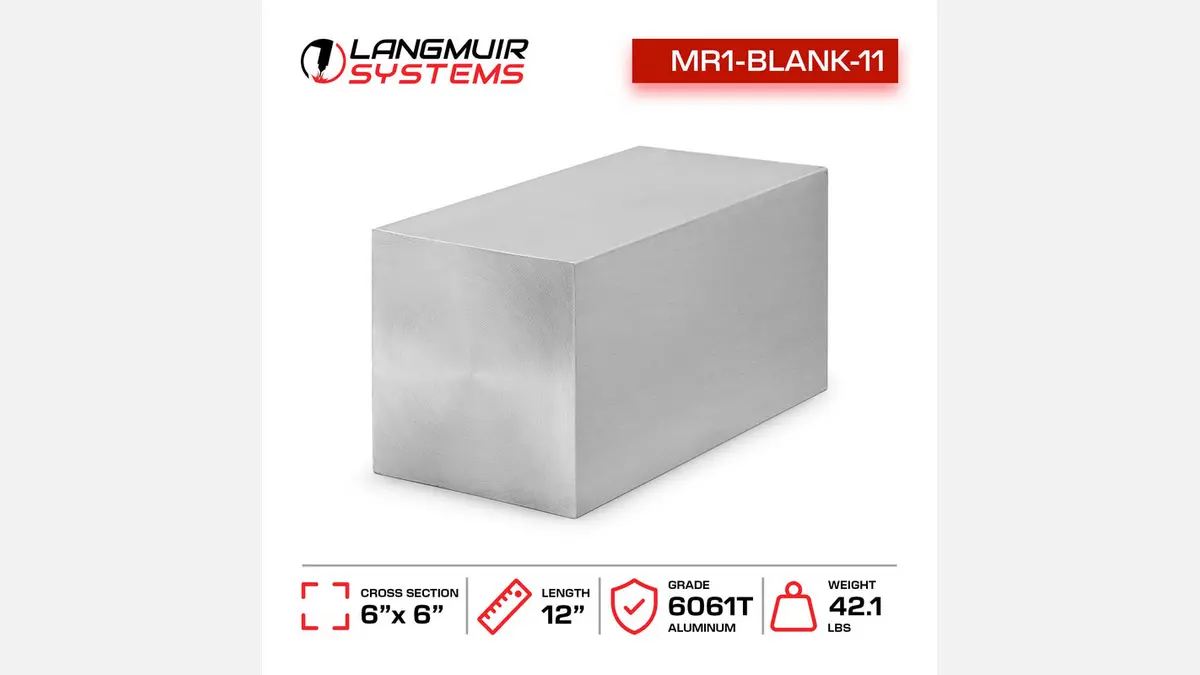
Image Credit: langmuirsystems.com
2011A Aluminum (AA 2011A) is a registered wrought aluminum–copper alloy developed primarily for high-speed automatic machining. Its high copper content supports useful strength after solution heat treatment and aging, while controlled lead and bismuth additions promote short, easily broken chips and a clean machined finish. Relative to 2011, 2011A has a lower iron maximum and a 4.5–6.0% copper range. It is therefore a practical choice for turned, drilled, tapped, and screw-machined parts where productivity and dimensional consistency outweigh welding and corrosion-resistance requirements.
| Chemical Composition wt.% | ||
|---|---|---|
| Element | Min | Max |
| Silicon | — | 0.40 |
| Iron | — | 0.50 |
| Copper | 4.5 | 6.0 |
| Zinc | — | 0.30 |
| Bismuth | 0.20 | 0.60 |
| Lead | 0.20 | 0.60 |
| Other elements, each | — | 0.05 |
| Other elements, total | — | 0.15 |
| Aluminum | Remainder | |
Composition notes
- Silicon: Maximum
- Iron: Maximum
- Zinc: Maximum
- Other elements, each: Maximum, unspecified other element
- Other elements, total: Maximum, unspecified other elements total
Registered wrought composition limits for 2011A, in mass percent. Aluminum is the remainder. The 0.05% each and 0.15% total limits apply to unspecified other elements; the specified lead and bismuth ranges are listed separately.
The Aluminum Association Teal Sheets report the calculated nominal density for the registered 2011A wrought designation. Strength, conductivity, and thermal values vary substantially with product form and temper and are not stated numerically in the supplied grade-specific source excerpts.
Use the button to switch between Metric and US Customary units.
| Physical Properties | Metric |
|---|---|
| Density | 2.82 Mg/m³ |
| Density | 0.102 lb/in³2.82 g/cm³ |
Test conditions & data notes
- Density: Calculated nominal density for active wrought 2011A
- Density: Calculated nominal density for active wrought 2011A
Material Conditions & Tempers
2011A is supplied in condition-specific wrought product forms. Mechanical performance must be specified by the applicable product standard, size, and temper; the alloy designation alone does not define minimum tensile or yield strength.
| Condition | Description | Notes |
|---|---|---|
| T3 | Solution heat-treated, cold worked, and naturally aged to a substantially stable condition. | A 2011A-T3 condition is identified by an independent material comparison source; obtain certified product data for required design values. |
| T4 | Solution heat-treated and naturally aged to a substantially stable condition. | Suitable where natural aging after solution treatment is specified. |
| T6 | Solution heat-treated and artificially aged. | Artificial aging is used to develop the specified T6 condition. |
| T8 | Solution heat-treated, cold worked, and artificially aged. | Used when a specification calls for post-solution cold work followed by artificial aging. |
Advantages & Limitations
| Advantages | Limitations |
|---|---|
|
|
Processing & Fabrication
| Process | Description |
|---|---|
| Machining | Use sharp tools, rigid workholding, and chip control appropriate to free-machining aluminum. The alloy’s lead and bismuth additions are intended to reduce long-stringer formation, making it well suited to high-volume turning and screw-machine operations. |
| Heat treatment | Where a heat-treated temper is required, use a controlled solution-treatment, quench, and aging route appropriate to the ordered product standard. T4 denotes natural aging after solution treatment; T6 denotes artificial aging. |
| Forming | Plan bending or other severe deformation around the selected temper. Heat-treated conditions provide greater strength but usually less forming latitude than softer starting conditions. |
| Joining | Prefer mechanical fastening or other qualified joining methods when practical. Do not assume ordinary fusion-welding practice will preserve the properties or machinability of the parent material. |
| Finishing and corrosion control | For exposed service, evaluate a suitable protective finish and the complete environment. Avoid specifying 2011A solely for corrosion resistance when a more corrosion-resistant aluminum alloy can meet the machining requirement. |
Applications
2011A is best used for repetitive precision components made from bar, rod, or similar wrought stock, especially where cycle time, chip control, and finish are key purchasing criteria.
- Automatic screw-machine parts: The lead–bismuth free-machining chemistry supports short chips and efficient production of high quantities of small turned components.
- Threaded fittings, adapters, and inserts: The alloy machines cleanly in operations that combine turning, drilling, and internal or external threading.
- Precision shafts, pins, and collars: Wrought stock and favorable machining behavior suit dimensionally controlled cylindrical components.
- Instrument and optical hardware: Small intricate parts can be machined with good finish where moderate corrosion exposure and welding are not central requirements.
- Electrical and mechanical connector components: It is useful for complex machined hardware when strength and machinability are more important than maximum electrical conductivity.
Standards & Designations
| Designation | Value | Description |
|---|---|---|
| Aluminum Association International Alloy Designation System | 2011A | Active registered wrought aluminum alloy designation; originally registered in 1982 by Switzerland. |
| Aluminum Association | AA 2011A | Common designation format for the same registered wrought alloy. |
| Temper designation system for wrought aluminum | T3, T4, T6, T8 | Temper is a separate condition designation and must be specified in addition to alloy 2011A. |
Frequently Asked Questions
What is the difference between 2011A and 2011 aluminum?
They are separate registered wrought alloys. In the Aluminum Association composition listing, 2011A has 4.5–6.0% copper and 0.50% maximum iron, while 2011 has 5.0–6.0% copper and 0.70% maximum iron. Both include lead and bismuth ranges for free-machining behavior, but they should not be substituted without checking the governing specification.
Why does 2011A machine so easily?
Its 0.20–0.60% lead and 0.20–0.60% bismuth additions are designed to promote chip breakage during cutting. This distinguishes 2011A from general-purpose structural aluminum alloys that can produce longer, more difficult-to-manage chips in high-speed automatic machining.
Is 2011A suitable for welded or outdoor corrosive service?
It is usually selected for machining rather than welding. The copper-rich, lead- and bismuth-containing composition makes it a less natural choice for fusion-welded assemblies, and its corrosion resistance is generally inferior to that of many 5xxx and 6xxx alloys. For exposed service, assess the environment and use a qualified protective finish or a different alloy where corrosion resistance is the primary need.
References & Data Notes
- (n.d.). Aluminum Association — International Alloy Designations and Chemical Composition Limits for Wrought Aluminum and Wrought Aluminum Alloys, Revised December 2025. https://www.aluminum.org/sites/default/files/2026-01/Teal%20Sheets%20December%202025.pdf
- (n.d.). 2011A-T6 Aluminum. https://www.makeitfrom.com/material-properties/2011A-T6-Aluminum
- (n.d.). 2011A-T3 Aluminum compared with 2024-T3 Aluminum. https://www.makeitfrom.com/compare/2011A-T3-Aluminum/2024-T3-Aluminum
Composition limits and calculated nominal density are taken from the Aluminum Association’s registered wrought-alloy listing. Numerical mechanical, thermal, and electrical values are intentionally not shown because the supplied excerpts do not provide verified values for a specific 2011A product form and temper.