MetalsAlloy
How Can You Successfully Weld Tool Steel Without Cracking?
Published:
Direct Answer: Key Steps for Welding Tool Steel without Cracking
Welding tool steel—a family of high-carbon, high-alloy steels designed for making tools, dies, and wear components—requires careful planning to avoid common pitfalls like cracking and brittleness. To reliably weld tool steels:
- Select the right welding method and filler metal matched to the grade and application.
- Preheat the tool steel thoroughly before welding to slow cooling, reduce cracking risk, and minimize residual stress.
- Choose a filler metal with good toughness and, when in doubt, slightly lower carbon than the base metal for improved crack resistance.
- Apply controlled heat input and avoid excessive dilution to keep the weld ductile.
- Use post-weld heat treatment (PWHT), such as tempering or annealing, to reduce brittleness and restore properties.
- Always follow manufacturer or datasheet advice for the specific tool steel alloy, product form, and hardness condition.
Let’s break down what this means in practical workshop terms.
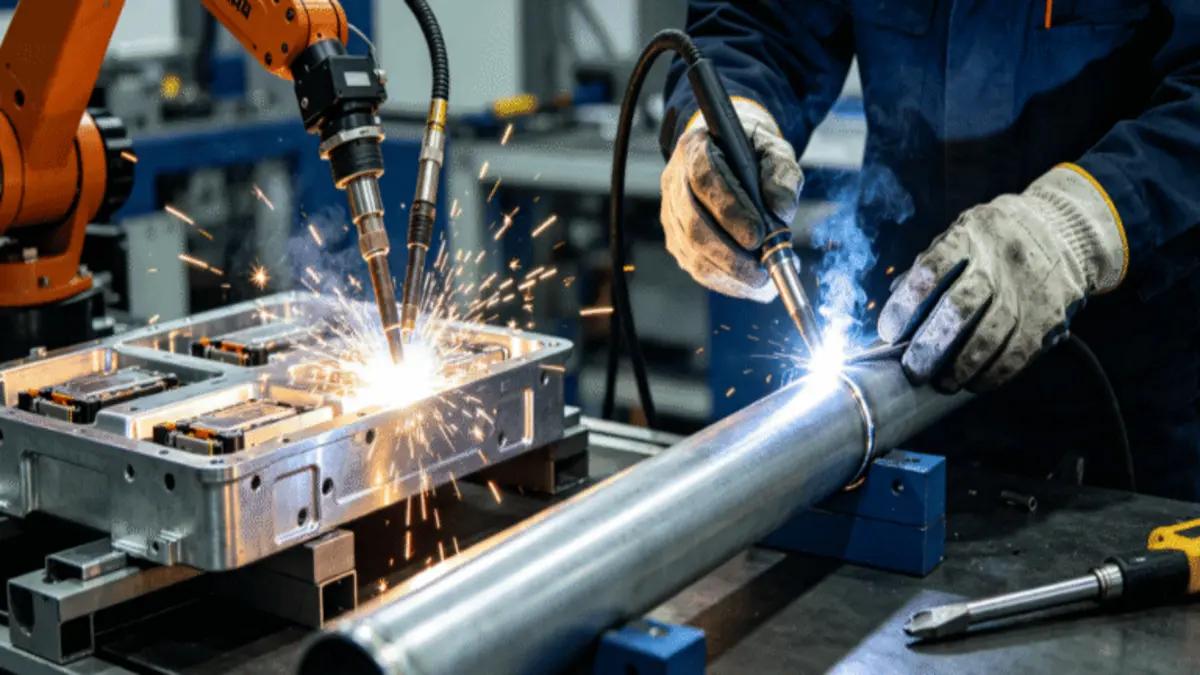
———–|——————–|——————————————–|——————————| | TIG (GTAW) | All tool steels | Clean, precise, low heat input; good control | Slower, needs skilled operator| | Stick/SMAW | Repairs, field work | Portable, many filler types | More spatter, higher HAZ | | MIG (GMAW) | Larger builds | Fast, can use alloyed wires | Less precise heat control | | Laser | Small repairs | Localized heat, minimal distortion | Specialized equipment |
Note: Fabrication shops often prefer TIG for best weld quality on tool steels. Laser welding is common for precise tool repairs.
Preheating Tool Steel: Why, When, and How
Why Preheat?
- Reduces cooling rate, thus lowering hardness and crack risk
- Allows hydrogen to dissipate, reducing delayed cracking
- Minimizes residual stresses at the weld and HAZ
What Determines Preheat Temperature?
Key factors:
- Carbon and alloy content: Higher values require higher preheat and slower cooling
- Section thickness: Thicker parts cool slower, but have more restraint
- Degree of restraint: Highly restrained (fixed) parts are more prone to cracking
Typical Preheat Ranges
(Consult your steel’s datasheet or supplier; the following table is a general reference)
| Tool Steel Type | Nominal Carbon Content | Preheat Temperature* |
|---|---|---|
| Water-hardening (W series) | 0.7–1.0% | 150–250°C |
| Cold-work (D, O, A) | 0.8–2.0% | 200–400°C |
| Hot-work (H series) | 0.3–0.5% + alloy | 300–500°C |
| High-speed (M, T series) | 0.8–1.5% + alloy | 350–600°C |
- Use the lower end for thinner parts, higher for thicker or highly restrained welds. Always refer to the steelmaker’s guidance.
Tips for Effective Preheating
- Use calibrated ovens, furnaces, torches, or induction heaters
- Monitor temperature with temp-sticks, thermocouples, or IR guns
- Maintain preheat during and between weld passes (interpass temperature)
- Allow slow, controlled cooling after welding—don’t quench or air-cool rapidly
Filler Metal Selection for Tool Steel Welding
Goals:
- Match or come close to base metal mechanical properties
- Favor a slightly lower carbon or more ductile weld metal to resist cracking
- Minimize dilution with base metal to avoid hard, brittle deposits
Common Filler Metal Choices
| Application Purpose | Filler Metal Type | Notes |
|---|---|---|
| Repair/build-up (TIG) | Tool steel-matched rod | E.g., ER312, custom tool steel filler |
| General crack repair | Austenitic stainless | 309, 312—tough, ductile, but soft |
| High hardness overlay | Hardfacing rod | Cobalt or alloy hardfacing for wear |
| Tough buffer/base layer | Low alloy or 312 rod | Reduces cracking, may be overlaid later |
- For welding dissimilar tool and non-tool steel: Stainless (309/312) prevents carbon migration and minimizes crack risk in the weld.
- Always ensure electrode or wire is low-hydrogen and dry.
Example Practical Process:
- Grind/clean the steel thoroughly to bare, shiny metal.
- Preheat to the recommended temperature.
- If using TIG, select a tool steel-matching or 312 stainless filler.
- Apply small, controlled weld beads.
- Allow the part to cool slowly under insulation.
- Perform post-weld heat treatment if the part needs to regain tool properties.
Post-Weld Heat Treatment (PWHT)
Why PWHT Is Important
- Relieves residual stresses in the weld and HAZ
- Softens excessively hard zones (prevents brittle fractures)
- Restores desired hardness, toughness, and wear properties
Typical Post-Weld Treatments
- Tempering: Reheating welded part below hardening temp, then slow cool. Usual for cold and hot work steels.
- Soak Annealing: For maximum softness and machinability, often after heavy welds or for new shaping.
- Aging or stress-relieving: For stabilized properties in large or highly restrained tools.
PWHT must be carefully chosen to match original tool steel properties and final use.
Avoiding and Diagnosing Cracking
Main Types of Cracks in Tool Steel Welding
- Hot cracking (solidification crack): Forms during weld solidification, often due to poor filler/base compatibility or high restraint.
- Cold/hydrogen cracking: Appears hours/days after welding, mainly in HAZ, due to rapid cooling and trapped hydrogen.
Preventive Strategies
- Always preheat and maintain interpass temperatures.
- Use low-hydrogen, matching or crack-resistant filler.
- Limit the size of weld beads to minimize heat affected zones.
- Allow for slow cooling and use insulation if needed.
- If cracks appear: Remove fully by grinding before repairing; inspect thoroughly before rewelding.
Special Considerations by Grade, Product Form, and Condition
- Annealed tool steel: Most weldable; can be preheated and slow cooled easily.
- Pre-hardened tool steel (lower HRC): Weldable with extra care; risks increasing hardness in HAZ or losing properties if overheated.
- Fully hardened tool steel (high HRC): Very difficult to weld; usually avoided.
- Forgings and thick sections: Require higher preheat, slower cooling, and staged welding to avoid severe internal stresses.
Practical Workshop Checklist for Welding Tool Steel
- Identify tool steel grade and condition.
- Clean the weld area thoroughly (no rust, grease, or coatings).
- Select correct preheat temperature for alloy and thickness.
- Choose a matching or tough, crack-resistant filler.
- Apply preheat, maintain interpass heat during welding.
- Weld with small beads, minimize heat input as needed.
- Allow for controlled cooling—insulate or slow-furnace cool if possible.
- Perform post-weld heat treatment according to needs of part.
- Inspect carefully for cracks, especially in HAZ zones.
Summary Table: Common Tool Steel Grades and Preheating
| Grade/Class | Alloying | Condition* | Typical Preheat | Weldability |
|---|---|---|---|---|
| W1 | High C | Annealed | 150–250°C | Poor |
| O1 | Med/High C, Cr | Annealed | 200–300°C | Poor/Fair |
| D2 | High C, Cr | Annealed | 250–350°C | Poor/Fair |
| H13 | Cr, Mo, V | Prehardened | 350–500°C | Fair (repair) |
| M2 | High C, W, Mo | Annealed | 400–600°C | Poor |
*Welds on annealed material are most practical; avoid hardened unless absolutely necessary.
Final Recommendations
- Welding tool steel is possible, but not easy. Only repair or modify when necessary.
- Preheat, proper filler selection, and post-weld treatment are mandatory for crack-resistance and performance.
- Always work in a controlled environment, and consult your tool steel supplier if in doubt about the suitability of weld repairs.
For further detail on specific grades, consult data from steelmakers or reputable welding technical sources.
References
High Carbon Steel Welding: Challenges & Practical ... (n.d.). facebook.com. https://www.facebook.com/BridgeWeldingMaterials/posts/high-carbon-steel-welding-challenges-practical-solutionshigh-carbon-steel-is-kno/1400270898784604
How to Weld High Carbon Steels: A Comprehensive Guide for Fabricators - WELDING ANSWERS. (n.d.). weldinganswers.com. https://weldinganswers.com/how-to-weld-high-carbon-steels-a-comprehensive-guide-for-fabricators
Preheating & post-weld heat treatments | ESAB United States. (n.d.). esab.com. https://esab.com/us/nam_en/esab-university/articles/preheating-and-post-weld-heat-treatments
Tips for Welding High Strength Steel. (n.d.). hobartbrothers.com. https://www.hobartbrothers.com/resources/technical-articles/tips-for-welding-high-strength-steel-and-selecting-filler-metals
Weldability of Materials - Carbon Manganese and Low Alloy Steels - TWI. (n.d.). twi-global.com. https://www.twi-global.com/technical-knowledge/job-knowledge/weldability-of-materials-carbon-manganese-and-low-alloy-steels-019
Welding Carbon Steel – Process, Methods, & Challenges. (n.d.). senlisweld.com. https://www.senlisweld.com/welding-carbon-steel
WELDING OF UDDEHOLM TOOL STEELS. (n.d.). uddeholm.com. https://www.uddeholm.com/app/uploads/sites/216/2024/06/tech_uddeholm-welding_EN_E10.pdf
What is Preheat?. (n.d.). lincolnelectric.com. https://www.lincolnelectric.com/en/welding-and-cutting-resource-center/process-and-theory/what-is-preheat