MetalsAlloy
What Are the Best Practices for Welding 4130 Chromoly Tubing?
Published:
Direct Answer: Best Practices for Welding 4130 Chromoly Tubing
When welding 4130 chromoly tubing, select your filler metal according to wall thickness, required ductility, and intended heat treatment. For thin-wall tubing in normalized condition (often used in frames and roll cages), ER70S-2 filler provides excellent ductility and crack resistance. ER80S-D2 offers higher strength for highly loaded structures but can be more sensitive to cracking. Preheat is not required for tubing under 3 mm (0.120 in.) thick but is recommended for thicker or quenched-and-tempered material. Post-weld heat treatment (PWHT) is usually only needed for thick, highly stressed, or Q&T assemblies; it is often not used (and may even be prohibited) in motorsport and aircraft applications. Cleanliness, material quality, and heat control during welding are essential to prevent brittle heat-affected zones and ensure strong, reliable welds.
———-|————-|—————————————————–|———————————————————-|———————————————————–| | ER70S-2 | A5.18 | Aircraft, bikes, roll cages, joints needing ductility| Lower strength, high ductility, crack-resistant | Most forgiving; common on thin wall and when no PWHT | | ER80S-D2 | A5.28 | Motorsport suspension, structural joints | Higher strength, less ductile, more crack-sensitive | For when base-metal strength match is a priority | | 4130 Filler | — | Assemblies receiving full PWHT | Matches base-metal chemistry and properties | Avoid unless PWHT performed; high risk of cracking as-welded |
For most thin-wall chromoly tube applications—especially in racing, aviation, and bicycles—ER70S-2 is preferred. Its lower strength and higher ductility mean less risk of cracking, especially where the structure obtains its strength from geometry, not weld deposit strength. Many top builders in motorsport and aerospace use this approach because it prioritizes resilience and safety.
ER80S-D2 is closer in strength to base metal and may be selected for highly loaded components. However, its weld metal is less forgiving and more prone to stress cracking if procedures aren’t followed perfectly.
4130-matching fillers should only be used if the welded part will be subjected to complete post-weld heat treatment (PWHT) to restore ductility.
Stick and MIG Fillers
- Stick (SMAW): Use E7018 or E8018-G, keeping electrodes dry. Low-hydrogen stick rods are mandatory for moderate to thick sections or field repairs.
- MIG (GMAW): Use matched solid wire (ER70S-2 or ER80S-D2) and argon-rich shielding gas. Not recommended below 2 mm wall thickness due to heat control limitations.
2. Preheat Requirements for 4130 Chromoly
When is Preheat Necessary?
Preheating reduces the risk of HAZ cracking and hydrogen entrapment by slowing the cooling rate and aiding hydrogen diffusion out of the weld zone.
Tubing Under 3 mm (0.120 in.) Thick and in Normalized Condition:
Preheat not usually required, as the risk of brittle microstructures in the HAZ is low. This covers most motorsport, bicycle, and light aircraft applications.
Wall Thickness Over 3 mm (0.120 in.) or Q&T (Quenched & Tempered) Material:
Preheat to 150–260°C (300–500°F) is recommended.
Required for mitigating HAZ hardness and for thicker weldments, castings, or components not in a normalized state.
Field Repairs, Heavy Sections, or When Using Stick Welding:
Always preheat as above. Maintain temperature throughout welding, checking with a temperature crayon or IR thermometer.
Preheat Best Practices
- Preheat the entire joint area and at least 1 inch beyond to the target temperature.
- Avoid excessive preheat (above 300°C/550°F), which can degrade mechanical properties.
- Never weld when tubing feels cold or “sweaty” to the touch—this increases hydrogen risk.
3. Post-Weld Heat Treatment (PWHT) for 4130 Chromoly
When PWHT is Needed
PWHT is a stress-relief or normalization process that restores ductility and toughness to the weld and heat-affected zone, especially for high-thickness, fully heat-treated, or critical applications. However, most thin-wall 4130 tube structures (like race car roll cages and aircraft fuselages) are NOT post-weld heat treated by practice and, in some regulations, are prohibited from being.
PWHT Is Recommended When:
- Welding heavy-walled (>3 mm) or highly stressed chromoly tubing assemblies.
- The base material is in the Q&T condition and must retain original mechanical properties.
- Required by the engineering or safety specification for the assembly.
PWHT Is Often Not Used When:
- Building SFI, FIA, or sanctioning-body-regulated roll cages, as rules prohibit altering base metal properties post-weld.
- Fabricating thin-walled, triangulated structures where joint ductility and crack resistance are the priority, and the overall design provides necessary strength.
Typical PWHT Procedure (When Required)
- Stress Relief: Hold at 540–650°C (1000–1200°F) for 30–60 minutes per inch of thickness, then cool slowly.
- Avoid rapid cooling which recreates brittle microstructures.
Do Not Confuse with Normalization
- Normalizing is a full heat treatment typically done after all welding and forming. PWHT for welds is simply a localized stress relief or partial normalization.
4. Welding Process & Technique for 4130 Chromoly Tube
Recommended Methods
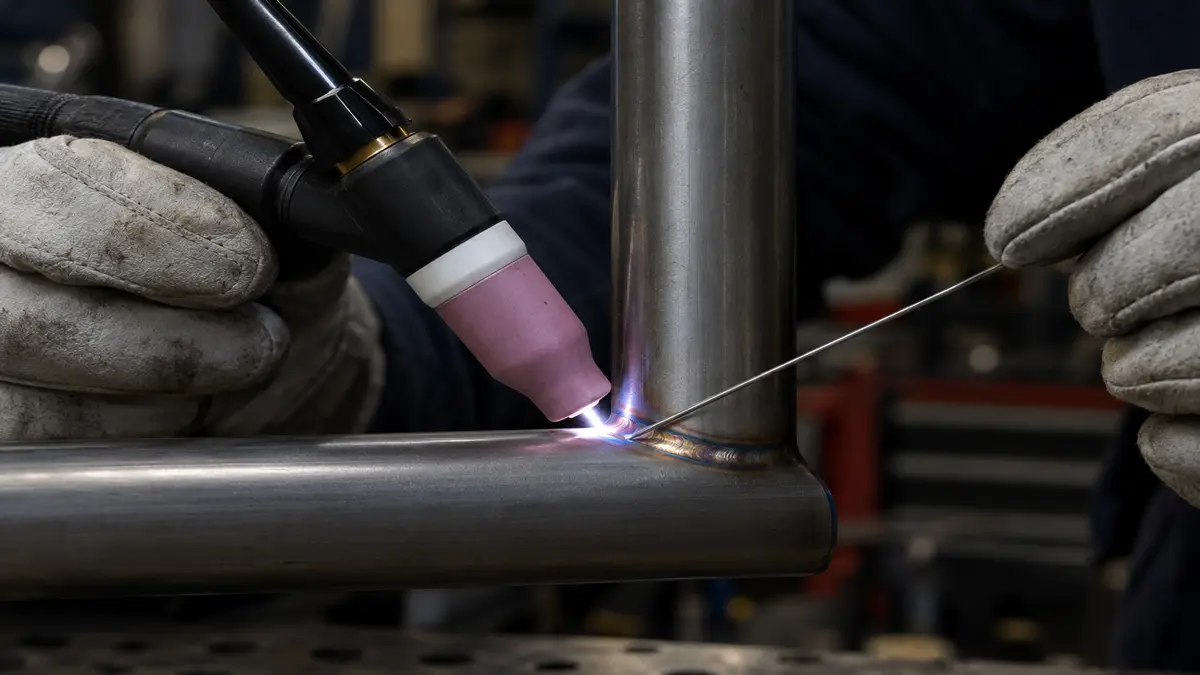
- TIG (GTAW): Provides best control. Use pure argon shielding gas, 2% lanthanated or ceriated tungsten, and a sharp point for the electrode.
- MIG (GMAW): Acceptable for thicker tube (>2 mm/0.080 in.), high productivity, or less critical jobs.
- Stick (SMAW): Useful for repairs and field situations using E7018/E8018-G rods with low hydrogen.
Key Best Practices:
- Always clean the base metal thoroughly–remove oil, scale, rust, and grease.
- Tight fit-up, careful joint prep, and no gaps reduce burn-through and avoid excessive filler.
- Use low heat input: Move briskly and avoid weaving unless filling large gaps.
- For thick multitube nodes or clusters, allow cooling between passes to prevent cumulative overheating.
- When using TIG on thin tube, consider pulsed current to limit distortion and grain growth.
5. Material Quality & Joint Preparation
- Always use certified seamless tube in the normalized condition for best weldability.
- Request an EN 10204 3.1 Material Test Report (MTR) with your tube order for traceability.
- For joint prep, bevel thicker tube and deburr all cut ends. A back purge with argon is beneficial but not always essential for low-thickness work.
Filler FAQ: ER70S-2 vs. ER80S-D2 vs. 4130
- ER70S-2—Safest for most roll cages, bike frames, and aircraft: Ductile and much less prone to weld cracking. Used as best practice when geometry, not the weld bead, determines structure strength.
- ER80S-D2—When stronger welds are needed and ductility is less critical (high load paths, some suspension joints).
- 4130 Filler—Only use if you will full-PWHT the weldment; otherwise, as-welded joints can be brittle and prone to cracking.
Special Cases: Dissimilar Metal Welding
Welding 4130 to stainless (e.g., 304L) or other alloys requires highly specific filler selection and procedures, usually involving a nickel-based filler like ERNiCr-3 for optimized impact resistance. For standard chromoly tube frame fabrication, this is not common, but is vital if integrating stainless parts.
Summary Table: Welding 4130 Chromoly Tubing
| Step | Best Practice |
|---|---|
| Base Material | ASTM A519 seamless 4130 tube, normalized condition |
| Filler Metals | ER70S-2 (ductility/forgiveness), ER80S-D2 (higher strength), |
| 4130 (only with full PWHT), E7018 (stick), matched MIG wires | |
| Preheat | Not needed under 3 mm wall; 150–260°C for thicker or Q&T tube |
| PWHT | Rare for thin tube frames; required for thick/Q&T/high-stress |
| Process | TIG preferred; MIG for >2 mm thickness; stick for field repairs |
| Cleanliness | Remove all oil, scale, and rust; prep all joints |
| Heat Input | Use lowest practical heat, minimize welding time in one spot |
| Regulations | Follow sanctioning body rules (e.g., SFI, FIA prohibit PWHT) |
| Documentation | Keep records of filler, tube supplier, and MTRs for traceability |
Final Tips for Reliable Chromoly Tube Welds
- Plan every weld—choose your filler before you pick up a torch.
- Preheat when in doubt for thicker or Q&T material.
- Avoid matching 4130 filler unless you will perform a complete PWHT.
- Focus on joint preparation and cleanliness for consistent, strong welds.
- For regulated structures (motorsport, aviation), check and follow all relevant rules.
Welding 4130 chromoly tubing does not require exotic techniques, but success demands strict adherence to process fundamentals: right filler, appropriate preheat, attention to heat input, and—in rare cases—post-weld stress relief. By following these best practices, you’ll maximize safety, reliability, and longevity in every chromoly tube structure you build.
References
Heat treating chromoly links. (n.d.). nc4x4.com. https://nc4x4.com/forum/threads/heat-treating-chromoly-links.198121
Heat treatment of 4130 chrome moly. (n.d.). forum.millerwelds.com. https://forum.millerwelds.com/forum/welding-discussions/7378-heat-treatment-of-4130-chrome-moly
Pairing the right heat treatment and filler metal for optimized welds. (n.d.). hobartbrothers.com. https://www.hobartbrothers.com/resources/technical-articles/the-right-pair-pairing-the-right-heat-treatment-and-filler-metal-for-optimized-welds
Preheating & post-weld heat treatments | ESAB United States. (n.d.). esab.com. https://esab.com/us/nam_en/esab-university/articles/preheating-and-post-weld-heat-treatments
Proper welding of 4130. (n.d.). race-dezert.com. https://www.race-dezert.com/forum/threads/proper-welding-of-4130.23544
Welding 4130 Chromoly to 304L Stainless: Filler Metal Selection. (n.d.). industrialmonitordirect.com. https://industrialmonitordirect.com/blogs/knowledgebase/welding-4130-tubing-to-304l-stainless-steel-filler-metal-guide
Welding 4130 Chromoly: Process, Filler, Preheat & PWHT Guide. (n.d.). hnyigesteel.com. https://hnyigesteel.com/welding-4130-chromoly
What filler rod to use for 4130 chromoly cage welding?. (n.d.). facebook.com. https://www.facebook.com/groups/242515173295634/posts/1096695284544281