MetalsAlloy
How Can You Prevent Corrosion of 304 and 316 Stainless Steel in Chlorinated Water?
Published:
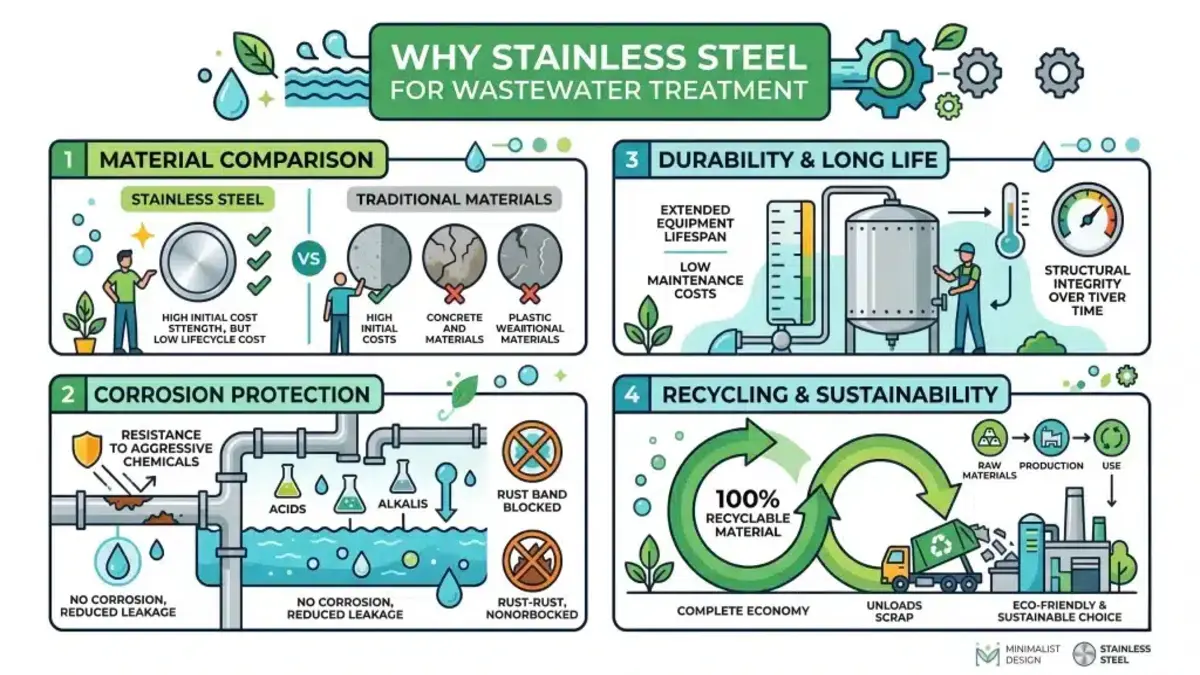
Direct Answer: Preventing Corrosion of 304 and 316 Stainless Steel in Chlorinated Water
Controlling the risk of corrosion in 304 and 316 stainless steel components exposed to chlorinated water demands a multipronged approach. Key measures include: using the correct alloy for the environment and concentration, ensuring proper fabrication and passivation, regulating chlorine and chloride levels, and ongoing monitoring and maintenance. For many typical water treatment or pool environments, 316 stainless steel (annealed, pickled, and passivated) is more resistant than 304, but corrosion can still occur if chlorine or chloride concentrations, temperatures, or environmental parameters exceed recommended thresholds.
This guidance primarily applies to wrought (rolled, seamless, or welded) austenitic stainless steel product forms—such as pipes, tubing, fittings, tanks, sheet, and plate—in fully annealed and properly passivated condition, as commonly specified for water treatment equipment and components.
—-|—————————–|——————————|—————————|——————————-| | 304 | 18% Cr, 8% Ni | Moderate (not recommended for high chlorine) | Up to ~200 | Moderate, increases with Cl⁻ & T | | 316 | 18% Cr, 10% Ni, 2% Mo | Superior, but not immune | Up to ~1000 | Lower than 304, still at risk |
Key Notes:
- 316’s added molybdenum gives improved resistance to pitting and crevice corrosion—vital in chloride-bearing waters—making it preferred for chlorinated environments.
- Both are susceptible to SCC above 50°C (122°F) and with elevated chlorides/chlorine.
Guidelines for Safe Chlorinated Water Use
1. Chlorine and Chloride Limits
- Residual free chlorine levels should be kept below 2 ppm for 304 and below 5 ppm for 316 under continuous exposure. Higher concentrations can be tolerated for brief cleaning but must be followed by a thorough rinse with chlorine-free water.
- Chloride ion limits for long-term exposure: up to 200 ppm for 304, up to 1000 ppm for 316 at neutral pH and ambient temperature.
- Total exposure time, temperature, pH, and oxygenation all impact corrosion risk. Elevated temperatures and low pH drastically reduce safe limits.
2. Product Form, Fabrication, and Condition
- Welds: Welded joints are prone to sensitization (loss of chromium at grain boundaries), increasing intergranular corrosion risk, especially in 304 unless properly solution annealed.
- Surface Finish: Polished, pickled, and passivated surfaces resist attack far better than as-fabricated or rough-finished material. Pickling removes iron contaminants introduced in manufacturing.
- Product Forms: Tubes, pipes, and sheet should be specified in annealed and passivated condition; avoid free-machining grades (like 303) that are less resistant to chlorinated environments.
3. Design Choices to Avoid Corrosion
- Avoid Dead Legs and Stagnant Zones: Ensure water circulation to prevent localized oxygen depletion and buildup of aggressive species.
- Minimize Crevices: Design joints, connections, and supports to limit tightly confined spaces vulnerable to crevice corrosion.
- Accessibility for Cleaning: Make all wetted surfaces accessible for periodic inspection and cleaning.
4. Passivation and Cleaning
- Initial Passivation: After fabrication, thorough cleaning, pickling, and passivation are crucial to form or restore the protective oxide layer. Avoid contact with carbon steel tools or surfaces.
- Regular Maintenance: Periodic flushing and cleaning mitigate accumulation of chlorinated compounds, especially in areas above the water line (splashed surfaces, condensation zones).
5. Monitoring and Water Treatment Controls
- Regular Water Testing: Monitor chlorine (free, combined, and total), chloride levels, pH, and temperature.
- Water Chemistry Optimization: Maintain pH in the neutral range (6.5–7.5) to minimize corrosion rates. Avoid acid conditions.
- Dechlorination: Limit the use of strong oxidizing biocides or alternate with less aggressive agents when possible.
- Dosing Strategy: Inject chemicals at points of high turbulence for rapid mixing and dilution; avoid concentrated chlorine contact with stainless steel.
When 304 or 316 Are Not Sufficient
For environments exceeding the safe limits, or where long service life and minimal maintenance are critical, alternative materials or higher-alloyed stainless steels may be needed:
- Duplex stainless steels (e.g., 2205 duplex): Tolerate much higher chloride concentrations (up to 3600 ppm).
- Super austenitic grades (e.g., 904L, 254 SMO): Superior resistance to pitting and SCC but at increased cost and fabrication complexity.
- Non-metallic linings (e.g., PTFE, FRP): For extreme chlorine exposure, consider using lined carbon steel or all-plastic systems instead of metallics.
Common Application Scenarios
Swimming Pools
Stainless steel rails, ladders, and tanks in pools are continuously exposed to treated water containing chlorine and chlorides. 316L is standard, but even it can corrode, particularly at joints and above the waterline in natatoriums where chloramines accumulate. Regular water chemistry monitoring and prompt cleaning of staining help extend service life.
Water Treatment Plants
Stainless steel is widely used in clarifier mechanisms, piping, and tanks. Pickled and passivated 316 stainless steel holds up well under typical municipal water chlorine levels, provided water is not too acidic and temporary cleaning concentrations are diluted and quickly rinsed.
Industrial Water Systems
For high-chlorine or high-temperature cleaning cycles, specify short exposure times for strong disinfectants and always flush with clean water. For continuous service at elevated chlorine or chloride levels, select higher-alloy material.
Table: Key Variables and Their Effect on Stainless Steel Corrosion
| Variable | Increased Corrosion Risk When… |
|---|---|
| Chlorine concentration | Exceeds recommended levels; higher risk of pitting and SCC |
| Chloride concentration | Approaches or exceeds grade limits |
| Temperature | Above 50°C/122°F |
| pH | Drops below 6.5 (acidic) |
| Oxygen content | Stagnant, poorly-aerated zones |
| Surface finish/condition | Rough, non-passivated, or dirty surfaces |
| Weld quality | Lack of annealing, presence of sensitization |
Practical Summary Checklist
- Select 316 (not 304) austenitic stainless steel for moderate chlorine/chloride environments; use duplex or super austenitic grades for severe exposures.
- Specify pickled and passivated surfaces; require solution annealing after welding if exposure is continuous.
- Limit residual free chlorine to manufacturer-recommended concentrations for the specific grade.
- Keep chlorides under 200 ppm for 304, 1000 ppm for 316, only in neutral pH water at ambient temperature.
- Avoid stagnant water, dead legs, and difficult-to-clean crevices in design.
- Passivate after fabrication and after major repairs; avoid carbon steel contamination during installation.
- Implement a maintenance program with periodic inspection, cleaning, and water parameter adjustments.
Conclusion
304 and 316 stainless steel can offer long, corrosion-resistant service in many chlorinated water applications if their limitations are understood and respected. The single most effective tactic is to control chlorine and chloride exposure beneath thresholds, combined with meticulous fabrication, post-processing, and ongoing maintenance. For environments where even 316 is unreliable, upgrade to duplex, super austenitic stainless, or non-metallic alternatives. Using the right alloy in the right condition, following robust water treatment, and prioritizing accessibility for inspection are the backbone strategies for successfully preventing chlorine water corrosion in stainless steel systems.
References
Does chlorine corrode stainless steel water tanks?. (n.d.). facebook.com. https://www.facebook.com/groups/1140539490220314/posts/1993867398220848
Effect of chlorine and chloride of cooling water on stainless metals. (n.d.). mitreh.com. https://mitreh.com/en/articles/Effect-of-chlorine-ions-on-stainless-steels
General - Archive | Chlorine and Stainless | Practical Machinist - Largest Manufacturing Technology Forum. (n.d.). practicalmachinist.com. https://www.practicalmachinist.com/forum/threads/chlorine-and-stainless.89729
Guidelines for Using Stainless Steel in the Water and ... (n.d.). tratamentodeagua.com.br. https://tratamentodeagua.com.br/wp-content/uploads/2017/05/selecao-de-acos-inoxidaveis-artigo.pdf
Selection of stainless steels for handling chlorine (Cl2) and chlorine dioxide (ClO2) – British Stainless Steel Association. (n.d.). bssa.org.uk. https://bssa.org.uk/bssa_articles/selection-of-stainless-steels-for-handling-chlorine-cl2-and-chlorine-dioxide-clo2
Stainless Steel Corrosion. (n.d.). eng-tips.com. https://www.eng-tips.com/threads/stainless-steel-corrosion.209474
Study of the Chlorine Influence on the Corrosion of Three Steels to Be Used in Water Treatment Municipal Facilities. (n.d.). pmc.ncbi.nlm.nih.gov. https://pmc.ncbi.nlm.nih.gov/articles/PMC10058086
the Pros and cons of Stainless Steel Use in natatoriums. (n.d.). bradyservices.com. https://www.bradyservices.com/wp-content/uploads/2018/07/Pros-and-Cons-of-Stainless-Steel-use-in-Natatoriums.pdf