MetalsAlloy
How Can You Bend Thin Brass Tube Without Kinking or Flattening?
Published:
Bending thin brass tubing is a delicate task—without proper technique, kinking, flattening, or wrinkling occur easily. Kinks destroy the roundness and mechanical integrity of the tube, which is critical in model-making, instrumentation, plumbing, and decorative applications. This tutorial covers proven, practical methods to bend thin-walled brass tube without kinking, focusing on small diameters (1–6 mm) in soft, half-hard, or fully-annealed seamless brass product forms.
Direct Answer: How to Bend Thin Brass Tube Without Kinking
To bend thin brass tube without kinking:
- Use internal support (like a fusible alloy or fine sand) during bending to maintain tube shape.
- Anneal the tube before bending to increase ductility, especially for half-hard or work-hardened brass.
- Employ the correct tube bender with a matching groove for the tube diameter.
The best and most reliable method for critical or tight-radius bends is filling the tube with a low-melting alloy such as Cerrobend (also known as Wood’s metal), then bending it while the filler supports the tube walls from within.
Why Brass Tubes Kink When Bending
Kinking occurs due to compressive buckling of the inside radius and stretching at the outside. Thin walls are especially prone to:
- Ovalization (tube loses roundness)
- Creasing (localized folding)
- Wrinkling (wavy inside radius)
Maintaining a round cross-section requires supporting the wall during bending, minimizing wall thinning, and reducing internal stress differentials.
Practical Techniques: Step-by-Step Methods
1. Cerrobend (Wood’s Metal) as an Internal Filler
What Is Cerrobend?
Cerrobend is a trademark for a low-melting-point bismuth-based alloy—also known as Wood’s Metal. It melts at about 70°C (158°F), so it’s liquid in hot water or with a heat gun but solid at room temperature. When poured into a tube and solidified, it acts a temporary mandrel, fully supporting the inside of the brass tube during bending.
Benefits
- Best for tight-radius bends and very thin wall tubing
- Preserves roundness even on complex bends
- Filler easily removed after bending by reheating
Step-by-Step Process
- Clean and Seal One End: Cap or plug one end of the tube to prevent leakage.
- Melt Cerrobend: Melt small pellets of Cerrobend in a suitable container using hot water or a heat gun.
- Pour or Inject: Pour the molten alloy into the tube. For very thin tubes, use a syringe or dropper.
- Cool and Solidify: Cool the tube in water or air until the alloy hardens.
- Bend the Tube: Use a tube bender or form by hand. The alloy inside supports the wall, preventing kinks.
- Remove the Filler: Heat the tube to above 70°C; the Cerrobend will liquefy and drain out. Collect for reuse (Cerrobend is expensive and reusable).
Safety Considerations
- Cerrobend and similar alloys may contain lead and cadmium—handle with gloves and avoid breathing fumes during melting.
- Never overheat; use ventilation.
Typical Applications
- Model exhaust pipes, scale railings, scientific tubing, and delicate decorative work
2. Sand Filling Method
For less demanding resolutions or when Cerrobend is not available, fine dry sand can be used as a granular mandrel.
Steps
- Seal One End: As above, cap or plug one end.
- Fill With Fine Dry Sand: Use a funnel and lightly tap tube to densely pack sand.
- Seal the Other End: Plug tightly (wax, tape, wood dowel, or tightly-fitting ball bearing).
- Bend Gently: Use a smooth form or tube bender. Sand prevents the tube from collapsing.
- Empty Sand After Bending: Unplug and pour out; use compressed air to blow out all particles.
Limitations
- Does not support as perfectly as Cerrobend—ovalization possible at very tight radii
- Sand can be abrasive—ensure tube interior is fully cleaned
- Not practical for very small-diameter or long tubes
3. Annealing Brass Tube Before Bending
Why Anneal?
Bending work-hardened or half-hard brass increases the risk of cracking and kinking. Annealing restores ductility, allowing for smoother bends.
Annealing Steps
- Clean the Tube: Remove oil and contaminants.
- Heat Evenly to Dull Red (~450°C/850°F): Use a gas torch, moving it evenly to avoid hot spots.
- Quench Immediately in Water: Contrary to steels, quenching does not harden brass—it merely cleans flux and cools.
- Ready for Bending: Once cooled and dried, the tube is now soft and more formable.
Notes
- Overheating can cause grain growth or oxidation; avoid excessive temperatures.
- Often paired with internal support methods above for best results.
4. Using a Tube Bender with a Proper Groove
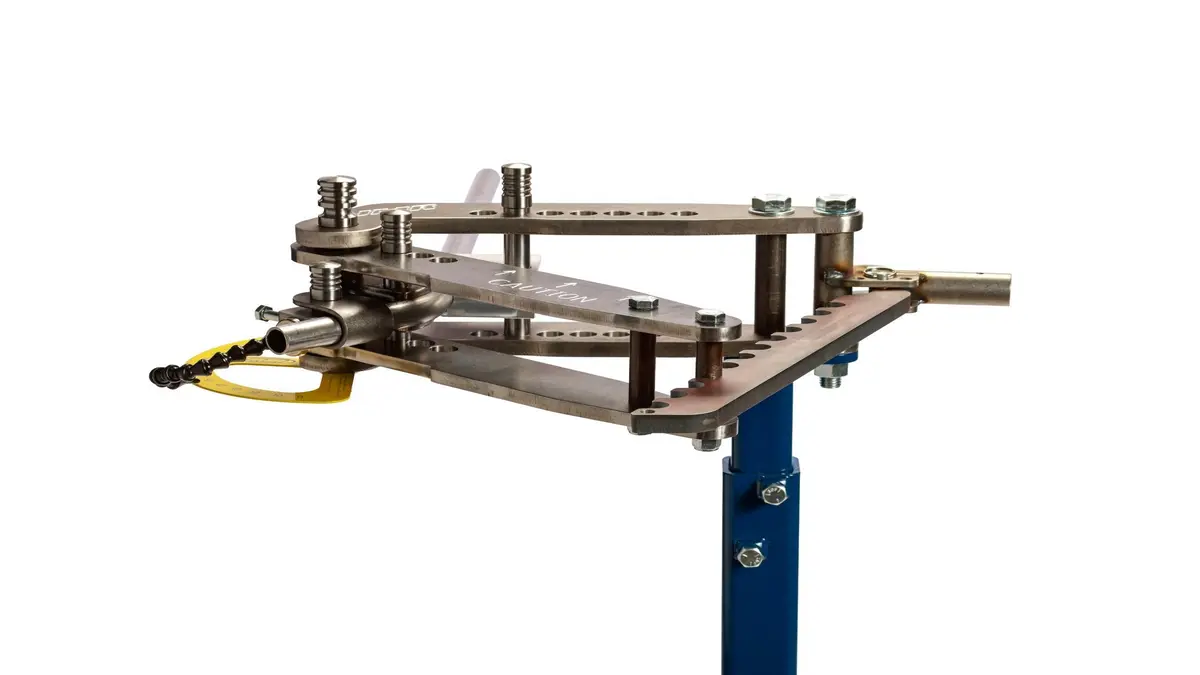
A dedicated tube bender with a groove sized to the tube diameter should be used for best results—never use pliers or make freehand bends. Tube benders prevent localized crushing and distribute bending stress across a smooth radius.
Types:
- Manual lever or rotary benders: For small diameters
- Mandrel benders (with mandrel inserts): For industrial or production settings
When to Use
- For medium-radius bends and larger diameter brass tubes (≥6 mm)
- Always in combination with annealing and/or internal fillers for tight bends
Comparison of Brass Tube Bending Methods
| Method | Kink Protection | Supports Thin Walls | Max. Bend Tightness | Reusability of Supplies | Cleanliness Post-Bend |
|---|---|---|---|---|---|
| Cerrobend Filler | Excellent | Excellent | Very tight | High | High (if cleaned) |
| Sand Filling | Good | Moderate | Moderate | High | Moderate |
| Spring Benders | Fair | Poor (thin tube) | Medium-Loose | High | High |
| Annealing + Bender | Varies | Varies | Varies | High | High |
Common Mistakes and How to Avoid Them
- Bending without annealing: Leads to cracks or unpredictable kinks, especially with half-hard brass.
- Insufficient filler compaction: Gaps in sand or Cerrobend allow tube collapse at those points.
- Overheating during annealing: Discolors the tube and may cause weakening.
- Improper tube bender groove: Groove too large or small will kink, scratch, or flatten the tube.
Special Considerations for Very Small Diameters (≤2 mm)
- Cerrobend is preferred—sand is difficult to fill and pack sufficiently in tiny tubes.
- Use a syringe or vacuum to help fill micro tubes with Cerrobend.
- For micro model parts, combine methods: anneal first, fill with Cerrobend, and bend using an accurately machined form or die.
Overview Table: When to Use Each Method
| Tube Wall Thickness | Tube Diameter | Best Method (for Kink-Free Bend) | Notes |
|---|---|---|---|
| 0.3–1.5 mm | 1–3 mm | Cerrobend Filler | To maintain roundness |
| 0.3–1.5 mm | 3–6 mm | Cerrobend or Sand Fill | Anneal if needed |
| 0.3–1.5 mm | >6 mm | Mandrel Bender + Mandrel Insert | For tight radii |
Summary: Best Practices for Kink-Free Brass Tube Bending
- For tight bends or very thin wall tubes: Use Cerrobend or Wood’s metal as internal filler—safe, effective, and reusable.
- For moderate bends and larger tubes: Packed fine sand can suffice.
- Always anneal brass tubing first if not already soft. This increases ductility and reduces fracture risk.
- Use professional tube bending tools, not makeshift pliers or mandrels.
Combining these guidelines ensures professional results and preserves the structural and visual qualities of even the most delicate brass tubes.
References
CS Alloys - CS Alloys Bend 158, CERROBEND. (n.d.). csalloys.com. http://www.csalloys.com/products-cerrobend-alloy.html
How to bend 1.5mm fine gauge brass tubing without kinking?. (n.d.). facebook.com. https://www.facebook.com/groups/811765288916408/posts/7671658756260326
How to bend a 25x300x1mm brass tube without kinking?. (n.d.). reddit.com. https://www.reddit.com/r/metalworking/comments/1673wal/how_to_bend_a_25x300x1mm_brass_tube_without
How To BEND and BEAD Brass Tube With A Homemade ... (n.d.). youtube.com. https://www.youtube.com/watch?v=1gKoOHDBhD4
Low Melt Fusible Bismuth Based Alloy Ingot Cerrobend. (n.d.). rotometals.com. https://www.rotometals.com/low-melt-fusible-bismuth-based-alloy-ingot-cerrobend
Pour me a mandrel. (n.d.). thefabricator.com. https://www.thefabricator.com/tubepipejournal/article/tubepipefabrication/pour-me-a-mandrel
Tube Bending Basics Explained: Techniques, Tools, and Materials. (n.d.). academy.ampcometal.com. https://academy.ampcometal.com/tube-bending-basics-explained-techniques-tools-and-materials
Wood’s metal - Wikipedia. (n.d.). en.wikipedia.org. https://en.wikipedia.org/wiki/Wood%27s_metal