MetalsAlloy
How Can You Bend 6061 Aluminum Without Cracking?
Published:
Direct Answer: How to Bend 6061 Aluminum Without Cracking
To reliably bend 6061 aluminum (especially T6 temper) without cracking, you must reduce its hardness and increase its ductility before bending, or use a sufficiently large bend radius. The most effective techniques are:
- Anneal the bend area (convert to O or T4 temper) by heating before bending—this makes the material much more formable.
- Use a minimum inside bend radius of at least 2.5–3 times the material thickness for 6061-T6.
- Whenever possible, bend in the O or T4 temper, then re-heat treat to T6 if needed for strength.
Below is a practical guide for fabricators seeking to bend 6061 aluminum (sheet, plate, extrusion, or tube) while minimizing risk of cracking.
Key Factors That Determine Bendability and Cracking Risk
Alloy and Temper
- 6061-O (annealed): Very soft, high ductility, ideal for bending. Minimal cracking risk.
- 6061-T4 (solution heat treated): Intermediate hardness, decent ductility, commonly bent at this stage and then aged to T6 after forming.
- 6061-T6 (fully hard): High strength, low ductility, very prone to cracking if bent without special precautions.
Other alloys such as 3003 or 5052 bend more easily, but for designs requiring 6061’s combination of strength and machinability, temper selection or annealing is essential.
Material Elongation
- 6061-T6 typically has 8-12% elongation—much less than alloys formulated for bending.
- Lower elongation = higher risk of cracking during forming.
Bend Radius
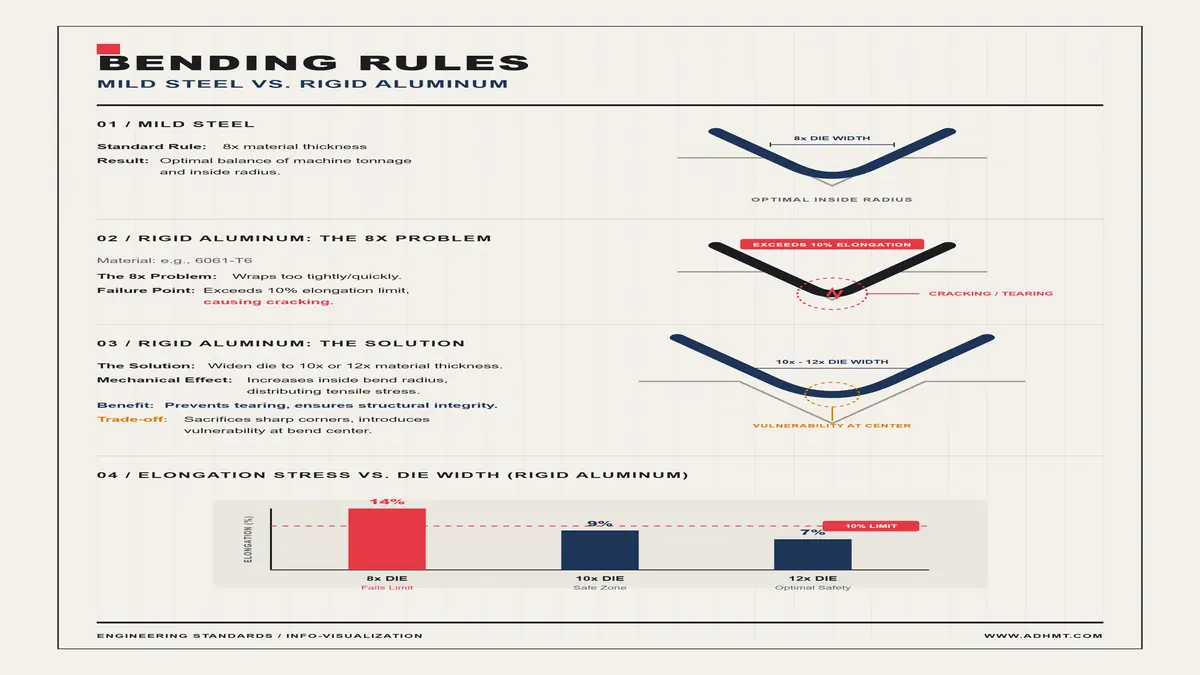
The inside bend radius (minimum bending radius) is the most important design parameter. Too tight (small) a radius concentrates strain and causes cracks, especially in hard tempers.
| Alloy & Temper | Recommended Minimum Bend Radius (Inside) | Practical Notes |
|---|---|---|
| 6061-O | 1.0 × thickness (T) | Very easy bending |
| 6061-T4 | 1.5–2.5 × T | Often bent in this condition, then aged to T6 |
| 6061-T6 | 2.5–3.0 × T | Large radii required; annealing or heating helps |
If the radius is too small, surface cracks are nearly guaranteed, especially on the outside of the bend. See the comparison below:
Grain Direction (Sheet/Plate)
- Bending across the grain (perpendicular to rolling direction) reduces cracking risk.
- Bending along the grain (parallel to rolling direction) increases cracking risk.
Product Thickness and Design
- Thicker sections need even larger radii to avoid cracks.
- Thin wall tube can collapse or wrinkle if not supported internally when bending.
Step-by-Step: How to Bend 6061 Aluminum Without Cracking
1. Select the Most Ductile Temper Possible
- If possible, order 6061-O or 6061-T4 for parts that require tight bends.
- If must start with T6, plan to locally anneal the bend region.
2. Anneal the Bend Area (6061-T6 Annealing)
Annealing softens the metal by dissolving precipitates, enabling the aluminum to stretch rather than crack.
Basic Annealing Steps:
- Mark the bend line on the aluminum.
- Use a propane torch or oven to heat the bend area to 340–390°C (650–730°F). Do not overheat (melting point ≈ 580°C/1,080°F).
- A common indicator: Rub soap (no additives) along the bend line; when it turns dark brown, the temperature is in the correct range.
- Allow the piece to cool slowly to room temperature.
After annealing, the aluminum is in a condition similar to O-temper and can be bent much more easily. After bending, it can be re-aged by heat treatment if T6 hardness is required for the finished part.
Note: Full solution heat treating and artificial aging are industrial processes requiring controlled ovens; consult heat treating specifications if final part strength is critical.
3. Choose Proper Minimum Bend Radius
- For 6061-T6, always bend with an inside radius at least 2.5–3 times the material thickness (i.e., don’t attempt a 90° bend with a 2 mm radius on 2 mm sheet).
- If possible, increase radius further, especially for thicker sheets, plates, or extrusions.
Practical Example
If you need to bend 3 mm (about 1/8") 6061-T6 sheet:
- Minimum inside radius: 7.5–9 mm (about 5/16"–3/8")
- Not recommended: Trying to achieve a 3 mm radius; cracking is very likely.
4. Control the Bend Orientation
- Mark the grain direction on the sheet.
- Bend perpendicular to the grain whenever possible.
- If the grain direction is unknown, test bends on scrap material can reveal the best result.
5. Use Suitable Bending Equipment and Tooling
- For sheet and plate: Use a press brake with a large-radius die set to avoid sharp bends.
- For tube bending: Use rotary draw or mandrel bending with sufficient radius and internal support to avoid ovalization or wrinkling.
- For extrusions or profiles: Be conscious of concentrated cross-sections and possible stress raisers; local heating is strongly recommended for tight features.
6. Consider Prototype Bends and Batch Testing
- Always perform trial bends on sample pieces (or scrap) before committing critical or expensive stock.
- Look for incipient cracks, surface lines, or tearing, and adjust process as needed.
Common Pitfalls and How to Avoid Them
Pitfall: Attempting Tight Bends in 6061-T6 Without Annealing
- Result: Surface cracking, part failure, rework costs.
- Prevention: Anneal the bend zone or specify O/T4 temper for forming.
Pitfall: Undersized Bend Radius
- Result: Cracks along the outside edge of the bend.
- Prevention: Increase inside radius; adhere to at least 2.5–3.0× material thickness for T6.
Pitfall: Ignoring Grain Direction
- Result: Intergranular cracks or complete failure of the bend.
- Prevention: Align bends perpendicular to the grain direction.
Pitfall: Rushed Manual Bending
- Result: Erratic bends, increased cracking rates.
- Prevention: Apply slow, steady pressure and proper tool alignment.
Bending 6061 Aluminum Tube and Pipe
Aluminum tubes are prone to both cracking and collapse during bending:
- Use the largest possible bend centerline radius; as a rule, centerline radius should be at least 4x the tube outer diameter for 6061-T6.
- Mandrel or internal wiper dies help prevent collapse and support thin walls.
- Annealing or bending in T4/O condition is recommended for tight radii or complex shapes.
- Test sample bends to confirm feasibility before batch production.
Post-Bending: Restoring Strength Through Aging
If you must restore full T6 hardness after bending:
- For parts bent in the T4 or O condition, solution heat treat and artificially age according to 6061 standards.
- This step is required only if the finished part requires maximum strength; many parts, such as decorative or non-structural brackets, may function with the lower as-bent strength.
Quick Reference Table: Process Choices for 6061 Bending
| Stage | Temper at Bending | Min. Bend Radius* | Cracking Risk | Action After Bending |
|---|---|---|---|---|
| No Preparation | T6 | 2.5–3.0 × T | High | Cracks likely |
| Annealed | O | 1.0 × T | Very Low | May need heat treat to T6 |
| As-supplied | T4 | ~2.0 × T | Medium/Low | Can age-harden to T6 |
| Bending with Heat | T6 locally heated | ~2.0 × T | Moderate | Varies; test for cracking |
*Bend radius is based on *material thickness (T).
Frequently Asked Questions
Q: Can you bend 6061 aluminum without heating? A: Yes, if the temper is O or T4, or if using a large enough radius (≥3× thickness). For tight bends in T6, heating (annealing) is almost always necessary to prevent cracking.
Q: Can I bend 6061-T6, then re-harden it? A: Yes. Bend in the O or T4 temper, then use standard solution heat treatment and artificial aging to restore T6 hardness if your part requires maximum strength.
Q: What is the best alloy for bending if strength is less critical? A: Alloys like 3003 or 5052 offer better formability and bend much easier than 6061. When strength and machinability make 6061 necessary, follow the recommendations above.
Q: How do I identify the grain direction? A: Grain direction is parallel to the long direction of the rolled sheet or plate. Often visible as faint marking lines; manufacturer datasheets or test bends can verify.
Summary Checklist: Practical Steps to Prevent Cracking in 6061 Bending
- Prefer O or T4 temper for forming. If starting with T6, anneal the bend zones.
- Use a generous bend radius: ≥2.5–3× material thickness for T6 (less for O or T4).
- Bend perpendicular to grain direction.
- Use correct tools and consider internal support for tube/pipe.
- Test your bending process on scrap/samples before production.
- Re-age if maximum strength is needed after forming.
By understanding and controlling temper, bend radius, orientation, and process conditions, you can fabricate reliable, crack-free bends in 6061 aluminum every time.
References
Aluminum Bending: The Comprehensive Guide. (n.d.). seathertechnology.com. https://seathertechnology.com/aluminum-bending
Bending 6061 aluminum : r/metalworking. (n.d.). reddit.com. https://www.reddit.com/r/metalworking/comments/ri60pk/bending_6061_aluminum
Bending Aluminum 101:How to Bend Aluminum. (n.d.). tzrmetal.com. https://tzrmetal.com/bending-aluminum-101
Bending aluminum, how would you go about bending 6061 ... (n.d.). facebook.com. https://www.facebook.com/groups/metal.fabrication.tips/posts/724052598749850
I need certain aluminum sections bent at 45° angles but ... (n.d.). facebook.com. https://www.facebook.com/groups/1577351835849505/posts/3363212620596742
Sheet Metal Fabrication Service: Precision Design to Avoid Minimum Bend Radius Cracking. (n.d.). lsrpf.com. https://www.lsrpf.com/blog/sheet-metal-fabrication-service-precision-design-to-avoid-minimum-bend-radius-cracking
Strategies for bending aluminum 6061-T6. (n.d.). thefabricator.com. https://www.thefabricator.com/thefabricator/blog/bending/strategies-for-bending-aluminum-6061-t6
The Fabricator - Strategies for bending 6061-T6 aluminum. (n.d.). thefabricator-digital.com. https://www.thefabricator-digital.com/thefabricator/august201808_2018/MobilePagedArticle.action?articleId=1415581