MetalsAlloy
What Is the Best Filler Rod for Welding 5052 to 6061 Aluminum?
Published:
Direct Answer: Which Filler for Welding 5052 to 6061 Aluminum?
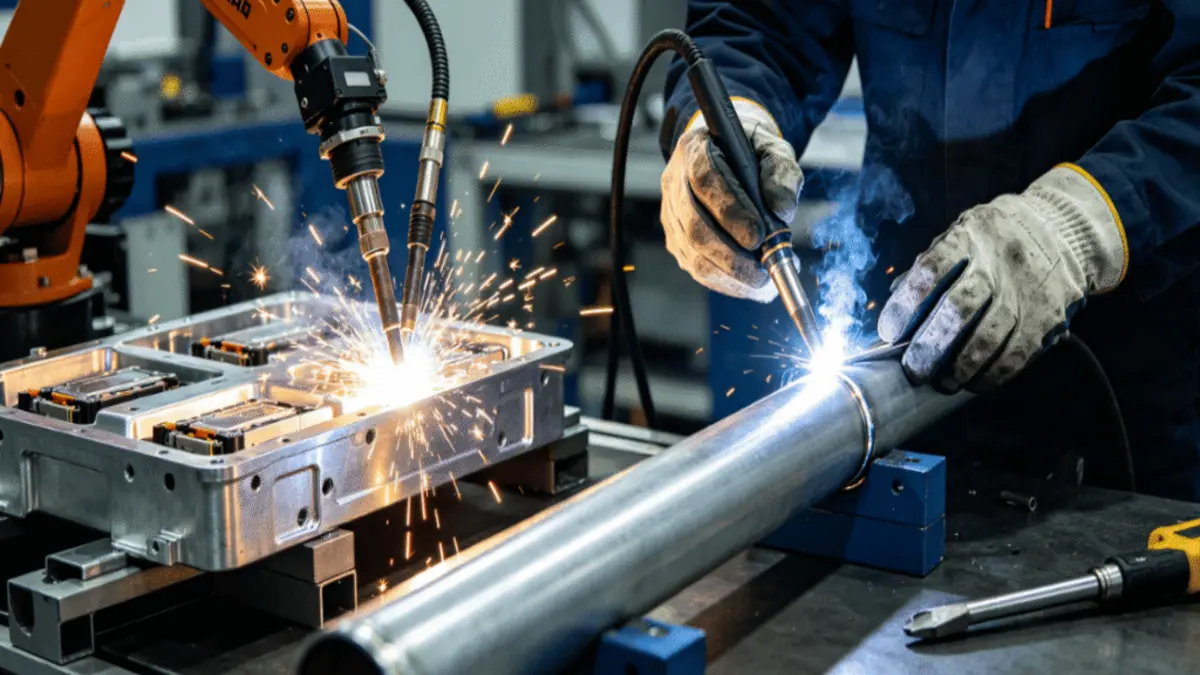
The most commonly recommended filler rod for welding 5052 to 6061 aluminum is ER5356, especially for most structural, marine, and general-purpose applications. However, ER4043 is sometimes used where maximum crack resistance or specific post-weld heat treatment is vital, and alternative rods like ER5183 or ER5554 can suit particular corrosion or strength requirements. The correct filler depends on exposure conditions, required strength, weld appearance, and whether the part will be heat treated after welding.
This guide covers aluminum sheet and plate welding, typically in the H32 (5052) and T6 (6061) tempers, using both TIG (GTAW) and MIG (GMAW) processes, and focuses on as-welded properties, not heat-treated joints.
———–|—————————————————————|————————| | ER5356 | High magnesium (5%), good strength, good saltwater resistance, best color match for anodizing | Structural, marine, general fabrication | | ER4043 | High silicon (5%), excellent crack resistance, soft weld bead, less compatible with salt water, grayer anodized color | Automotive, extrusions, cast-aluminum repairs | | ER5183 | Higher strength 5xxx, improved fracture toughness and corrosion resistance over 5356 | Tough marine/cryogenic applications | | ER5554 | Matches 5454/5083, good for sustained elevated temperature, moderate strength | Chemical tanks, some marine tanks |
ER5356: The Most Versatile Filler for 5052 to 6061
- Strength: Provides high as-welded tensile strength (comparable to welds in 6061 and 5052 sheet)
- Corrosion Resistance: Excellent, recommended for saltwater/marine service
- Crack Sensitivity: Low for these alloys
- Color/Finish: Good match after anodizing; weld bead appearance is bright
- Best For: General fabrication, marine, outdoor enclosures, automotive, and boat components made from 5052 and/or 6061 sheets, plates, or extrusions
ER4043: For Special Needs
- Strength: Lower than 5356 as-welded, especially relevant if full T6 strength is not restored after welding
- Corrosion Resistance: Not suitable for marine—can pit or corrode in salt environment
- Crack Sensitivity: Highest resistance among common fillers, good for 6xxx series extrusions prone to cracking
- Color/Finish: Turns gray with clear anodizing; may not match the base material
- Best For: Situations needing highest crack sensitivity, some automotive parts, where anodizing color match is not critical
ER5183 and ER5554: Niche Uses
- ER5183: Used for maximum as-welded strength and fracture toughness (notably in 5083/5086 marine structures), but rarely needed for routine 5052/6061 welds
- ER5554: Recommended occasionally for chemical tank or container service, moderate strength, not preferred for high-load joints
5356 vs 4043 Filler: Detailed Comparison
When it comes to welding 5052 to 6061, the main debate is between ER5356 (magnesium) and ER4043 (silicon). Here’s how they compare:
| Property | ER5356 | ER4043 |
|---|---|---|
| Composition | 5% Mg | 5% Si |
| As-Welded Strength | Higher | Lower |
| Crack Resistance | Good | Best |
| Corrosion Resistance | Excellent (marine) | Poor (marine) |
| Anodized Color Match | Good (match) | Grayish (contrast) |
| Ductility | Slightly lower | Higher |
| GTAW/MIG Suitability | Excellent | Excellent |
| Use With 5052/6061 | Preferred | For specific cases |
Conclusion: Use ER5356 for most joints involving 5052 and 6061, especially in marine or outdoor conditions, or where weld color and strength matter. Use ER4043 if the highest crack resistance is needed and corrosion exposure is minimal.
Special Considerations for Marine Aluminum Welding
- Always use 5356 (or high-magnesium 5xxx fillers like 5183) for marine environments.
- Silicon-bearing fillers such as 4043 are not recommended for welds exposed to salt water: they increase pitting and reduce corrosion life.
- For parts with 5052 base metal in boats, tanks, or enclosures, ER5356 is favored for its magnesium content and compatibility with both alloys.
Structural Welds and Load-Bearing Applications
- Weld strength at the joint is limited by the lower-performing heat-affected zone (HAZ) beside the weld, especially in 6061-T6 which loses much of its temper near the bead.
- ER5356 filler yields the highest as-welded strength for combined 5052/6061 joints, with typical tensile strength in the mid-20 to mid-30 ksi range, depending on section and weld quality.
- Structural joints in frames, supports, and mounting brackets nearly always use 5356 (or 5183 for the absolute highest strength in marine hulls).
Weld Appearance and Post-Finishing
If the welded assembly will be clear anodized:
ER5356 offers the best color match to both 5052 and 6061, resulting in uniform appearance.
ER4043 will turn dark gray, creating a noticeable color difference at the weld area.
For painted or powder-coated parts: Either filler can be used, but 5356 still provides better corrosion performance and color uniformity under the coating if thin or edges are abraded.
Post-Weld Heat Treatment Considerations
Most 5052 and 6061 assemblies are not post-weld heat treated. As-welded joint properties are what matter.
If post-weld heat treatment is required (rare for this combination), consider:
4043 provides a more stable, low-crack weld bead through heat cycles, but does not restore 6061’s full T6 strength.
5356 is not appropriate for high-temperature service or repeated heat cycling: avoid above 150°C (302°F) due to risk of stress corrosion or softening.
For most practical purposes, plan all welds as “as-welded.”
Product Forms and Typical Conditions
- 5052 is usually supplied as H32 sheet or plate (strain-hardened, stabilized)
- 6061 is usually supplied as T6 sheet, plate, bar, or extrusion (solution heat-treated and artificially aged)
- The filler recommendations above apply to joining these wrought products by welding, using either TIG (GTAW) or MIG (GMAW) processes.
Practical Table: Filler Selection Cheat Sheet
| Application Conditions | Recommended Filler | Reason |
|---|---|---|
| Outdoor/general fabrication | 5356 | High strength/corrosion resistance |
| Marine or saltwater exposure | 5356 or 5183 | Essential for longevity, best resistance |
| Chemical tanks (no saltwater) | 5554 | Reduced risk of stress corrosion at warm temps |
| Highest crack resistance only | 4043 | Weld shape/tolerance for non-marine, non-structural |
| Anodized finish | 5356 | Best visual color matching |
| Post-weld heat treat required | 4043 (rarely) | Stable weld, but assess strength and HAZ carefully |
Practical Summary
- Use ER5356 for nearly all welds joining 5052 to 6061 where strength, corrosion resistance, or appearance in marine or outdoor service are important.
- Use ER4043 only in rare situations where maximum crack resistance is required, and the joint will not face saltwater or require color-matched anodizing.
- ER5183 or ER5554 are niche filler choices for special marine or chemical environments, but less common for basic 5052/6061 welds.
- Always match the filler not just to the metals, but to the environment and finish requirements of your project.
- For most fabricated sheet or plate assemblies—structural boat parts, vehicle enclosures, HVAC housings, tanks—choose 5356 and follow best practice in cleaning, fit-up, and post-weld finishing for the longest service life.
Related topics:
- 5052-H32 vs 6061-T6: Alloy and temper basics
- Factors affecting weld strength and corrosion life
- Tips for successful aluminum MIG/TIG welding
References
5052 vs 6061 Aluminum: Formability vs Strength | American Steel & Aluminum. (n.d.). americansteelandaluminum.com. https://americansteelandaluminum.com/resources/materials/5052-vs-6061-aluminum
6 Key Factors to Choose the Right Aluminum Filler Metal. (n.d.). esab.com. https://esab.com/us/nam_en/esab-university/articles/6-key-factors-to-choose-the-right-aluminum-filler-metal
6061 vs 5052 Aluminum: Which Alloy Is Right for Your Project?. (n.d.). rialtomfg.com. https://rialtomfg.com/blog/6061-vs-5052-aluminum
Differences Between 5052 and 6061 Aluminum | Cumberland Metals. (n.d.). cumberlandmetals.com. https://www.cumberlandmetals.com/articles/5052-aluminum-vs-6061-aluminum-whats-the-difference
The Best Weldable Aluminum Alloys: 5052, 5083, 6061 Comparison ... (n.d.). premiumalu.com. https://premiumalu.com/discover-the-best-weldable-aluminum-alloys-of-2025
Understanding 5052 Aluminum vs 6061: Properties Guide. (n.d.). tzrmetal.com. https://tzrmetal.com/5052-aluminum-vs-6061
Welding alloys for aluminum. (n.d.). app.aws.org. https://app.aws.org/forum/topic_show.pl?tid=26731
welding aluminum 5052-h32 to 6061-t6 - Eng-Tips. (n.d.). eng-tips.com. https://www.eng-tips.com/threads/welding-aluminum-5052-h32-to-6061-t6.170572